Warm Golden Blonde: Professional Formula Guide for Spring 2026
Cross-brand warm golden blonde formula at levels 8-9 with Wella, L'Oréal, Schwarzkopf and Alfaparf equivalency table. Protocols by starting base and developer volumes.
Blendsor
Blendsor Team
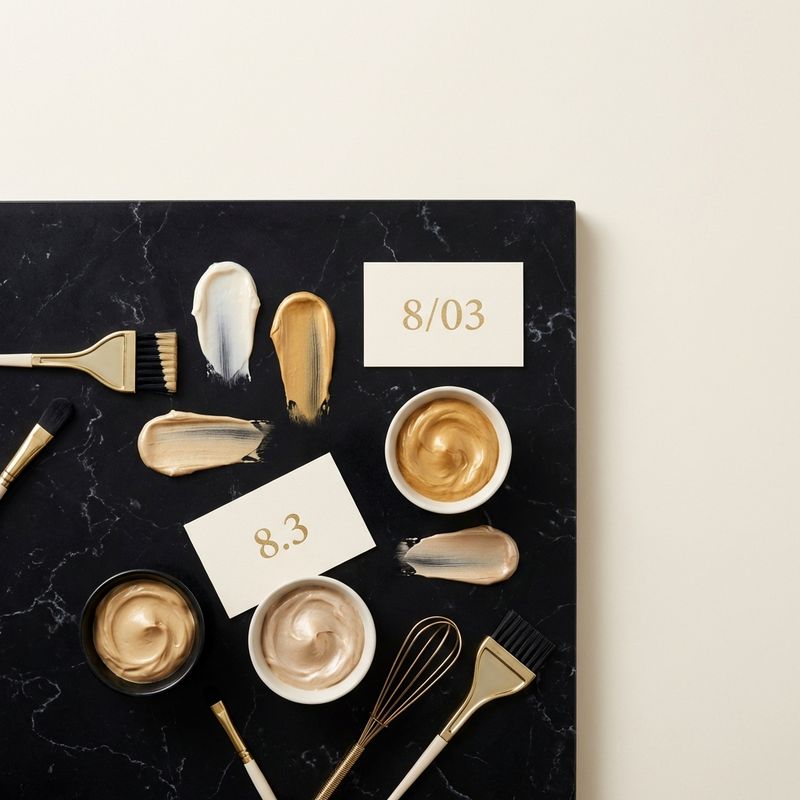
How many times have you seen that luminous golden blonde —the one that glows without shouting, the one that looks like natural filtered light— and wondered exactly what goes inside the bowl?
Because warm golden blonde isn’t just dropping a 8.3 and waiting. There’s a logic behind it. One that separates luminous gold from unwanted brassiness. And that difference lives in the formula.
It is also a shade that holds through the whole year, not only in the spring months: the same gold that reads as filtered light in April reads as warm depth in autumn, and the formula barely moves. What changes is the base you start from and how much warmth the hair has already picked up.
Here it is in full: cross-brand, by starting base scenario, with the mistakes that ruin it and how to prevent them.
Quick summary: Warm golden blonde is a level 8-9 blonde with natural golden reflect (.03/.3) that delivers warm luminosity without turning brassy. It’s formulated with 20-30 volume developer depending on the starting base. The key is controlling gold saturation and adding violet corrector when the base has an orange underlying tone.
What exactly is warm golden blonde — and why isn’t it the same as bleaching to yellow?
Warm golden blonde lives between levels 8 and 9 on the color chart. Its signature is natural golden reflects —coded .03 in Wella, .3 in Majirel and Alfaparf— that add warmth without oversaturating the tone.
The most common confusion: mistaking it for hair that was bleached and turned yellow. They have nothing in common.
| Characteristic | Warm Golden Blonde | Uncontrolled yellow |
|---|---|---|
| Level | 8-9 with gold pigment | 9-10 without pigment |
| Reflect | Natural gold (.03/.3) | Yellow without control |
| Underlying tone | Managed with developer | Exposed, unneutralized |
| Luminosity | Golden, deep | Dull, oxidized |
Warm golden blonde has intentional pigment. Unwanted yellow is a lack of control. That’s the technical difference that makes it a professional tone.
To understand the underlying tones that emerge when working at levels 8-9, the hair color levels guide breaks down each zone of the spectrum in detail.
Base diagnosis: the step that determines the protocol
Before touching the bowl, you need to read four variables. Without this diagnosis, any formula is a shot in the dark.
Real hair level
Warm golden blonde requires a starting base between level 6 and 8 at minimum for the result to be predictable. Below level 6, the orange underlying tone competes with the gold and pulls the result toward unwanted copper reflects.
Previous chemical history
Is there existing color? How many lightening services? A virgin level 7 and a level 7 with three previous color services behave completely differently with the same 8/03.
- Virgin or previous highlights: predictable structure, standard protocol
- Accumulated previous color: higher porosity, uneven absorption, risk of darker result or unexpected reflect
- Previous lightening in specific areas: possible hyper-lightening in those zones
Percentage of gray hair
Gray hair absorbs pigment differently. With more than 30% gray, the gold can oversaturate in those areas due to higher absorption capacity. In those cases, adding 10-15% of the same base without reflect (.0) stabilizes consistency across the strand.
Porosity
High porosity accelerates absorption and can intensify the golden reflect beyond what’s desired. Even so, the developer is set by the lift you need, not by porosity: on porous hair the peroxide gets in sooner, so raising the volume only adds oxidation and more colour bleed afterwards. What porosity adjusts is timing and monitoring — cut processing by 5-8 minutes and check visually. Exception: when the colour has to lift or cover gray and the manufacturer’s data sheet sets 20 vol as the minimum to develop, the data sheet rules.
If you need guidance on evaluating porosity before formulating, the hair elasticity and porosity test article covers the full protocol.
Cross-brand equivalency table: warm golden blonde across color systems
This is what colorists search for most: knowing that Wella 8/03 is not exactly the same as Majirel 8.3, even though both are “light golden blonde.” Here are the real differences.
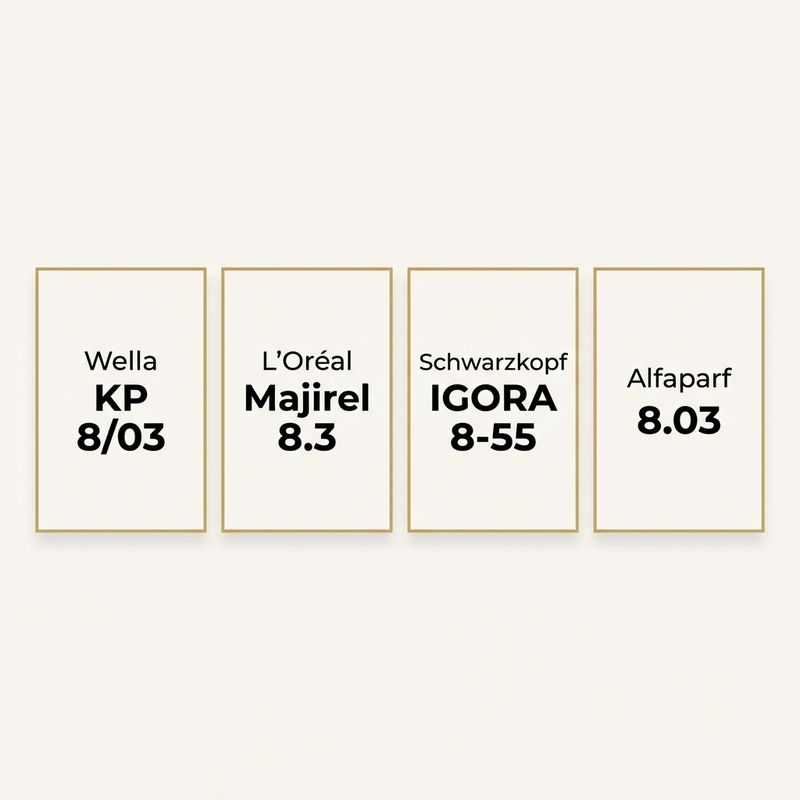
| Brand | Code | Official name | Dominant reflect | Gold intensity |
|---|---|---|---|---|
| Wella Koleston Perfect ME+ | 8/03 | Light Blonde Natural Gold | Natural + soft gold | Medium-low |
| Wella Koleston Perfect ME+ | 8/3 | Light Blonde Gold | Direct gold | Medium |
| L’Oréal Majirel | 8.3 | Light Golden Blonde | Warm gold | Medium |
| Schwarzkopf IGORA Royal | 8-55 | Light Blonde Gold Extra | Intense gold | High |
| Revlon Revlonissimo | 8.3 | Light Golden Blonde | Natural gold | Medium-low |
| Alfaparf Evolution | 8.03 | Light Slightly Gold Blonde | Natural with golden touch | Low |
Key interpretation notes:
- 8/03 Koleston (Natural + gold): softer result, ideal for bases with residual warmth. Less saturation than pure 8/3.
- 8/3 Koleston: more pronounced gold, better on neutral or slightly cool bases where you deliberately want to add warmth.
- 8-55 IGORA: the “Gold Extra” in the -55 code means high gold intensity. Use it when you want a very luminous result or when the base is slightly cool. On already warm bases it can oversaturate.
- 8.03 Alfaparf: the .03 signals “slightly natural gold,” the most subtle reflect in the table. Perfect for clients who want warm golden without it being too obvious.
Recommended developers by brand (1:1 mix ratio for all except Majirel at 1:1.5):
| Brand | Level 6 virgin base | Level 7 with previous color | Level 8 refresh |
|---|---|---|---|
| Wella Koleston | 30V (9%) | 20V (6%) | 20V (6%) |
| L’Oréal Majirel | 30V + 35 min | 20V + 35 min | 20V + 25 min |
| IGORA Royal | 30V (9%) | 20V (6%) | 20V (6%) |
| Alfaparf Evolution | 30V | 20V | 20V |
Application protocol by scenario
There’s no single protocol for warm golden blonde. The same code gets applied in three different ways depending on the starting base.
Scenario 1: Level 6 virgin base → target level 8-9 golden
The base is 2-3 levels below the target. You need real lift.
Protocol:
- Formula: Wella KP 8/3 + 9% (30 volume), 1:1 ratio
- Time: 45 minutes per Wella Koleston Perfect manual
- Application: root to ends, starting at more resistant areas (occipital zone)
- Check at 30 minutes: if the underlying tone is already at golden yellow, it may be ready earlier
Professional tip: On warm level 6 bases (orange-yellow underlying tone), add 5-10% of 8/16 (pearl) to slightly cool the gold and prevent the result from shifting toward copper. Warm golden should feel like sunlight, not orange.
Scenario 2: Level 7 base with previous color → refresh toward warm golden
The hair already has accumulated pigment. The priority is depositing the gold without overloading.
Protocol:
- Formula: Wella KP 8/03 (gentler than 8/3) + 6% (20 volume), 1:1 ratio
- Time: 35-40 minutes
- Application: mid-lengths and ends first (more porous), roots the last 10 minutes
- Key: 8/03 on a level 7 base with previous color gives a more controlled result than 8/3
Professional tip: If the previous color was a cool or ash blonde, 20V alone may not be enough to shift the reflect. In that case, use 30V on new root growth only and 20V on the rest.
Scenario 3: Level 8 base → warm golden tone refresh
The base is already at the right level. You only need to refresh the warmth and add golden shine.
Protocol:
- Formula: Alfaparf 8.03 or Majirel 8.3 + 6% (20 volume)
- Time: 20-25 minutes (Majirel: maximum 25 min on refresh)
- Application: lengths and ends. Roots only if there’s obvious regrowth
- Result: softer tone, golden luminosity without structural change
To understand why 30 volume sometimes doesn’t deliver the lift you expect, the article on why 30-volume developer delivers fewer levels than promised explains the real behavior of oxidants.
The mistake that turns warm golden into brassiness — and how to prevent it
Here’s the trap. Gold is the most tempting reflect to oversaturate because visually it seems “warmer, more brilliant.” But there’s a point where gold becomes brassy, and once that line is crossed, clients perceive it as cheap salon color rather than a deliberate tone.
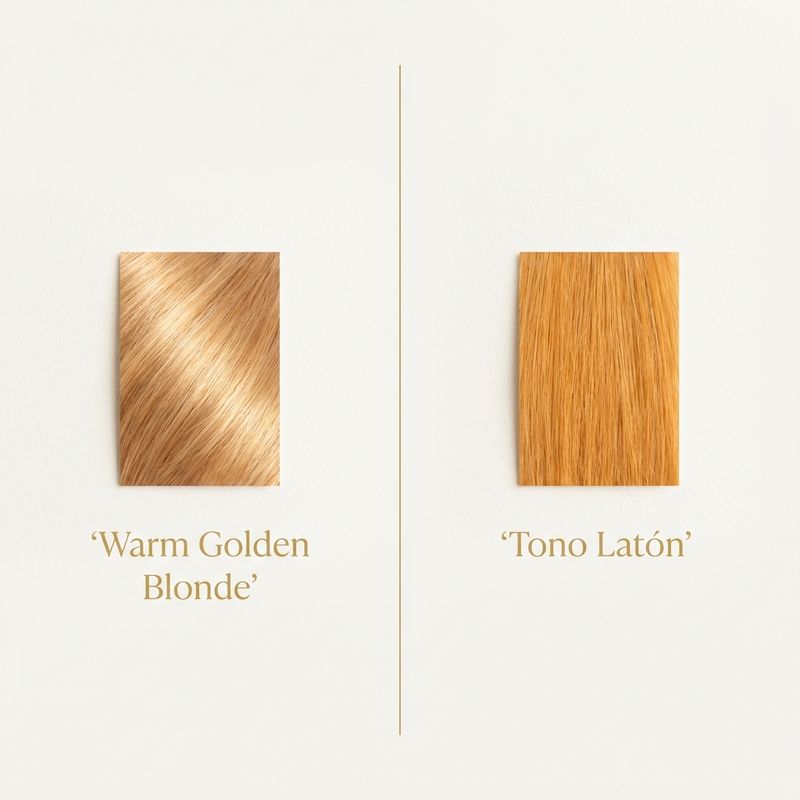
Why brassiness occurs
Three main causes:
- Gold overdeposition: mixing pure 8/3 (high intensity) over a base that already has an orange-yellow underlying tone. The result stacks warmth on top of warmth.
- Developer too high: using 30V on bases already at level 8 overexposes the underlying tone and reveals residual yellow before the pigment stabilizes.
- Excessive processing time: exceeding the manual’s recommended time with high-gold formulas oversaturates the cortex and the result darkens and amberizes.
Technical solution: correction with .1 or .18
According to the Schwarzkopf IGORA Royal Technical Manual, when the base presents a pronounced warm underlying tone (level 8 with yellow undertone), the recommendation is to add 5-10% ash corrector (.1 or .18) to the mix.
- Corrector .1 (ash): neutralizes yellow. Use when the underlying tone is clear yellow.
- Corrector .18 (ash-violet) or equivalent: more specific for yellows with a greenish component. Minimum 5-10% —more than that grays the result.
The balanced formula on a warm base would be, for example: 80% KP 8/03 + 20% 8/1 with 20V. The 20% ash cools the gold just enough to make it feel “golden” rather than “brassy.”
For the full theory on neutralizing unwanted tones, the neutralizing unwanted tones article covers complementary color logic in depth.
Frequently asked questions about warm golden blonde
What’s the difference between warm golden blonde, honey blonde, and caramel blonde?
All three are warm tones but they live at different levels. Warm golden blonde sits at levels 8-9 with natural golden reflects (.03/.3): it’s the most luminous and blonde of the three. Honey blonde moves between levels 7-8 with amber and honey reflects —warmer and less blonde—. Caramel blonde descends to levels 6-7 with golden-brown tones that add depth. The simple rule: the lower the level, the more brown-warm the tone; the higher the level, the more luminous-golden.
How do I prevent warm golden blonde from going yellow over time?
Progressive yellowing has two causes: natural pigment oxidation and mineral deposits from water. To slow it down, recommend that clients use a violet toning shampoo once a week (not every wash, as it can overcool the gold). Violet-pigment shampoos neutralize oxidized yellow without stripping the underlying golden warmth. Avoiding very hot water when rinsing also helps.
How long does warm golden blonde last?
With proper maintenance, the tone’s intensity holds for 6-8 weeks. After that, the golden reflect begins to lose saturation and the hair may shift toward a more neutral or slightly yellow blonde. How long the freshness lasts depends heavily on porosity history: more porous hair releases pigment faster.
What’s the difference between Wella KP 8/03 and 8/3?
8/03 blends the natural reflect (.0) with gold (.3) in a balanced proportion: the result is a soft, integrated gold that doesn’t stand out aggressively. 8/3 is pure gold without the natural modifier: more saturated, more visible, with more warmth. For clients seeking “subtle but present” warm golden, 8/03 is the choice. For those who want gold with more presence, 8/3. On already warm bases, always start with 8/03.
Can I formulate warm golden blonde over hair with gray coverage needs?
Yes, with adjustment. At high gray percentages (over 40%), the gold pigment can oversaturate in those areas due to the higher absorption capacity of white hair. Add 10-15% of the same base without reflect (e.g., 8/0 in Wella) to the formula to homogenize absorption. The result will be warm golden without hypersaturated gray strands.
Should I use a permanent color or a demi-permanent toner after lifting to warm golden blonde?
It depends on how far the lift went. If the hair sits at level 8-9 after lightening and you only need to deposit gold, a demi-permanent at 10 volume is the safer choice: it deposits the reflect without further lift and stresses an already-processed cortex less. Reach for permanent color with 20 volume only when you still need one level of lift or when you need to cover gray in the same pass. On previously lightened hair, a permanent formula with 20V often over-processes what is already open and lets the gold grab unevenly at the ends. As a rule: if there is nothing left to lift, do not use a formula designed to lift.
Why does warm golden blonde come out uneven between the regrowth and the lengths?
Because they are two different chemical scenarios sharing one bowl. The regrowth is virgin hair with natural pigment and body heat helping the process along; the lengths are porous, previously processed, and absorb faster and darker. Applying a single mix from root to ends is what produces the classic split result — brassy roots and muddy, oversaturated ends. The fix is to split the formula: higher developer on the regrowth (20-30V depending on the lift needed) and a gentler deposit-only mix on the lengths (10V demi, or the same code at half the gold percentage), applied in the last 10-15 minutes so both zones finish together.
Summary
- Warm golden blonde is a level 8-9 with intentional golden reflect (.03 or .3 depending on brand): it is not bleached hair that turned yellow.
- The code you choose depends on the starting base and the gold percentage you need: IGORA 8-55 for maximum intensity, Alfaparf 8.03 for the most subtle result.
- Developer: 30V on virgin level 6-7 bases, 20V on level 7-8 bases with previous color or refresh.
- The key mistake: overdepositing gold on already warm bases. Solution: add 10-20% ash corrector (.1/.18) to the mix.
- Yellowing is prevented with weekly violet toning shampoo —not daily— and lukewarm water when rinsing.
Want to calculate the exact warm golden blonde formula for your client’s specific starting base, including corrector proportion and time adjusted for porosity? Blendsor generates personalized warm golden blonde formulas based on level, chemical history, and your working brand.
What's the difference between warm golden blonde and regular golden blonde?
In the app, we ask you a question like this one, but about your own client.
Up for this week’s case? → More on blondes and lightening →Related articles
Practice with our colorimetry tools
Calculators, neutralization wheel, AI consultation...
The Blendsor newsletter
Color techniques and trends for professionals. No spam.
You know the theory. What about today's case?
Send a photo to the Blendsor advisor and get an answer grounded in colour theory: toner, developer and timing, with the brands on your shelf.
Ask about your caseWritten by the Blendsor team
Professional hair colorimetry experts with experience in AI-assisted formulation. We combine color science, salon practice and technology to help colorists formulate with precision.