Warm Honey Blonde: Professional Formulas by Starting Level
Learn how to formulate warm honey blonde by starting level. Professional formulas, differences from other blondes, and common mistakes to avoid.
Blendsor
Blendsor Team
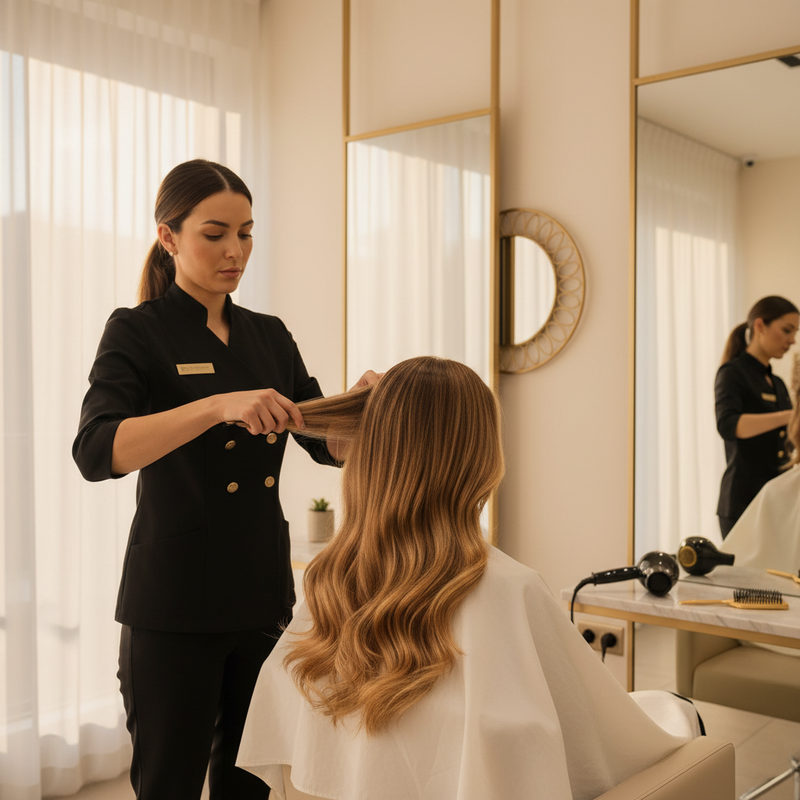
Does your client want a blonde that looks natural, luminous, and warm, without tipping into brassy yellow?
If you’re a professional colorist, this request will sound familiar. And while it sounds simple, getting a beautiful warm honey blonde means understanding what sets it apart from other warm blondes and how to approach it based on starting level.
In this article you’ll see what defines this tone, what level it sits at, how to approach it from each starting level (with what the brands’ instructions actually say) and the mistakes that turn a gorgeous honey blonde into a flat, lifeless yellow.
Quick summary: Warm honey blonde is a level 7-8 blonde with a gold reflect, sometimes with a touch of copper, softened with some natural so the gold doesn’t saturate. In Wella’s numbering, gold is the /3: its US store describes it as “for adding rich, golden warmth to hair”. How you get there depends on the starting level: from a 5 you need to lift (with lightener and a toner afterwards, or with a permanent colour if its instructions give that much lift); from a 6, a permanent colour that lifts one or two levels; from a 7 or 8, deposit only, with a demi-permanent toner or a gloss. Before any oxidative colour, an allergy test, and not on the same day as the colour appointment.
What Is Warm Honey Blonde and What Level Is It?
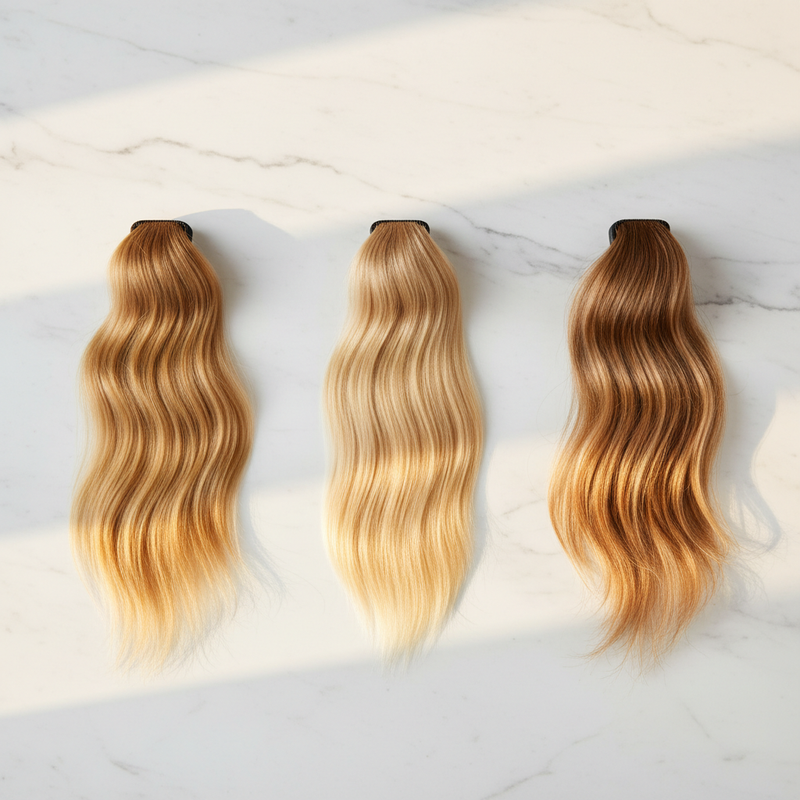
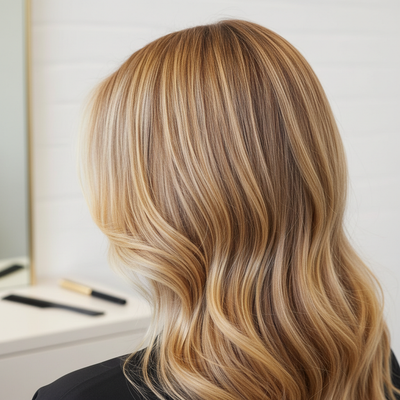
Warm honey blonde is a blonde between level 7 and 8 with golden and caramel undertones reminiscent of natural honey. It’s not a flat blonde or a saturated gold: it has depth, controlled warmth, and the kind of luminosity that makes hair look healthy.
How do you spot it on a shade chart? By the reflect more than by the level. Honey is a gold, on its own or with a touch of copper, with some natural if you want to soften it. On Wella’s US store blog, the /3 is “gold (yellow)”, used “for adding rich, golden warmth to hair”. Brands also use “honey” as a shade name at other depths: Redken’s 2024 Shades EQ chart calls its 010WG “Honey Gold”. So the honey you’re after is found on your own line’s chart, not in a generic code.
Looking for a warm honey bronde? The depth sits lower and a brown reflect joins the gold. The same Wella blog describes its /7 as “brown (red, yellow, blue)”, meant “for your bronde (brown-blonde) formulas”.
This shade fits within the hair color trends among the warm blondes. It’s very close to Teddy Bear Blonde, which spans levels 7 to 9 and has its own honey variant, and it sits above caramel, which is darker. Clients who want something more neutral and creamy often end up choosing cashmere blonde instead.
| Feature | Warm Honey Blonde | Golden Blonde | Caramel Blonde | Teddy Bear Blonde |
|---|---|---|---|---|
| Target level | 7-8 | 8-9 | 6-7 | 7-9 |
| Dominant undertone | Golden-caramel | Pure gold | Copper-gold | Gold-honey |
| Warmth | Medium | High | High | Medium-high |
| Saturation | Soft | Intense | Medium | Soft |
How Do You Formulate Warm Honey Blonde by Starting Level?
Honey blonde is approached differently depending on starting level. From a 5 you need to lift: with lightener and a toner afterwards, or with a permanent colour if the hair is natural and your line’s instructions give that much lift. From a 6, a permanent colour with the developer its instructions give for one or two levels of lift is enough. From a 7 or 8 you only deposit the reflect, with a demi-permanent toner or a gloss. Ratio, developer and timing come from each product’s instructions; here’s what some lines say.
The key to honey blonde is achieving the golden-caramel undertone without going too yellow or falling short on warmth. The trick is adapting your approach to the client’s natural level and to what the strand test tells you. And before any of it comes the allergy test, not on the day of the colour appointment: each line’s timing is in the box at the end of this section.
Level 5: Light brown
The most demanding starting point. To reach a 7-8 you have to lift, and the underlying pigment that shows up on the way is warm: on the lightening curve in the Koleston Perfect usage guide, level 7 exposes orange-yellow and level 8, yellow. That underlying pigment can’t take over the result.
There are two routes:
- Lighten with lightener, then tone. It gives the most control over the underlying pigment. Powder and developer at the ratio your lightener’s instructions set. On the scalp, Wella’s Blondor fact sheet says “For on-scalp application, use a 6 % or below”, and its US lightening guide asks for developer “not exceeding 6%/20 Vol”. The same fact sheet caps processing: “Do not exceed 50 mins”. On virgin hair, the root goes on last: Wella explains in its guide to hot roots that heat from the scalp “can cause the formula to process faster”. You rinse when the underlying pigment reaches what you need, not by the clock. The full protocol is in the professional bleaching guide.
- A permanent colour that lifts, on natural hair. How much it lifts comes from the instructions: the Koleston Perfect usage guide gives 9% Welloxon Perfect (30 Vol) 2 levels of lift, and the IGORA Color System wall chart lists 9% (30 Vol) for lifting 2-3 levels with Igora Royal. If the hair already carries colour, don’t count on this route.
Before choosing, do a strand test with the same mix you plan to use: it tells you how much that hair lifts and what underlying pigment it leaves. If the hair has been lightened, relaxed or permed, check elasticity on that same strand. How to do both: the strand test and the hair elasticity test.
Pro tip: From a 5, don’t chase honey with a heavily loaded gold in a single step. The underlying pigment that lifting exposes is already warm and adds to the gold in the tint: the result tends towards dirty yellow. Lighten first, look at the underlying pigment, tone second.
Level 6: Dark blonde
The most rewarding level for honey blonde: you only need to lift one or two levels, and the warm underlying pigment already contributes part of the warmth you’re looking for.
How to approach it: a gold permanent colour at your target level, softened with a natural at the same level if the gold alone feels too much, and the developer the instructions give for that lift. Here the lines don’t agree. The Koleston Perfect usage guide gives 6% (20 Vol) 1 level of lift and 9% (30 Vol), 2. The IGORA wall chart lists 6% (20 Vol) for lifting 1-2 levels. With the same 20 vol, one line leaves you at a 7 and another can take you to an 8. The mixing ratio also comes from the instructions: Koleston Perfect, for example, mixes 1:1 with its Welloxon Perfect (60g of colour + 60g of developer in the guide). Timing is whatever your line’s instructions set.
Level 7: Medium blonde
Here you only need to deposit the reflect, not lift. This is the ideal level for a blonde balayage with a natural honey result.
How to approach it: a gold demi-permanent toner at your target level, with the low-volume developer or the product’s own processing solution, as its instructions set. One example: Redken presents Shades EQ Gloss as “a Demi-Permanent Toner”, mixed “in a 1:1 ratio” with its Processing Solution and processed “at room temperature for 20 minutes”.
Level 8: Light blonde
The challenge is not losing warmth. A level 8 tends to look washed out if you don’t deposit enough gold. This is gloss or gold toner territory, and you judge the balance on the test strand: more gold if it stays pale, more natural if it turns yellow. This is your warm honey blonde toner step; how to choose and apply it is in the professional hair gloss guide. And if what you’re looking at is more orange than honey, correct that first: which toner goes with each type of orange.
Allergy test: almost everything above is oxidative colour (a permanent colour, a demi-permanent or a gloss mixed with developer), and so is an oxidative toner after lightening. Wella’s Koleston Perfect leaflet says to always perform an allergy test 48 hours before any colour service. If your product’s instructions give no timing, don’t do it on the same day as the colour appointment. Redness, burning or itching at the test site means that colour is not applied, and the client should seek medical advice before colouring again. Anyone who has ever had an allergic reaction to hair colour isn’t coloured at all. How to fit it into your bookings: the 48-hour allergy patch test.
What Role Does Developer Play in Honey Blonde?
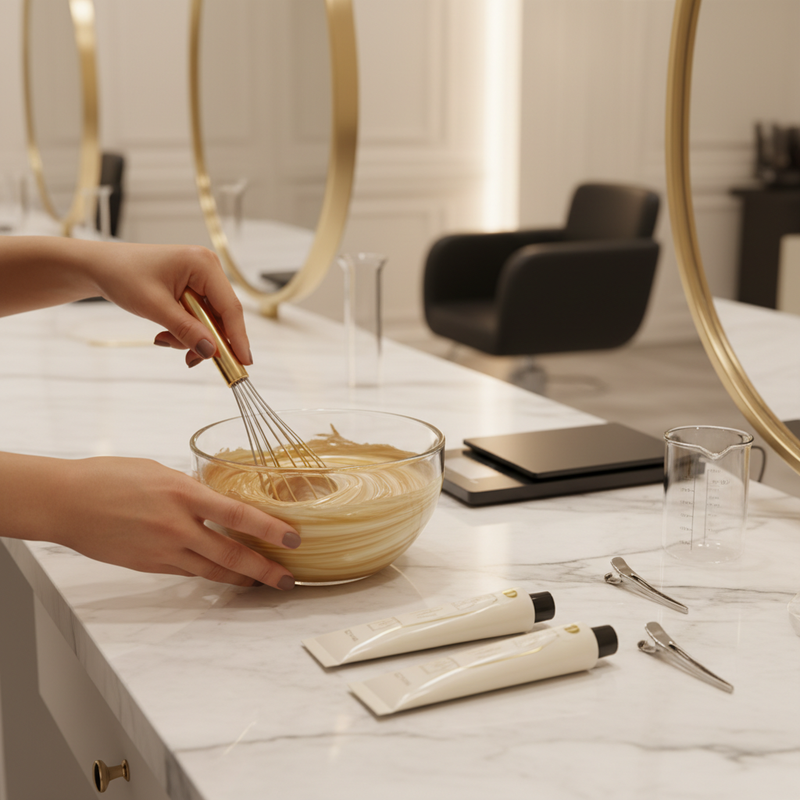
Developer decides how much the mix lifts, and that matters as much as the tonal mix. To lift, the volume your line’s instructions give for the levels you need to climb. To deposit without lifting, a low-volume developer or the deposit product’s own processing solution. And with lightener on the scalp, the limit its instructions set.
Choosing the right developer volume is just as important as the tonal mix. A volume error can turn your honey blonde into straw yellow.
| Starting level | Service it needs | What the developer decides |
|---|---|---|
| 5 | Lift: lightener and toner, or a permanent colour that lifts on natural hair | The volume your instructions give to reach a 7-8; with Blondor on the scalp, 6% (20 Vol) or below |
| 6 | Direct colour that lifts | The volume your instructions give for one or two levels (Koleston Perfect: 20 Vol for 1 level, 30 Vol for 2) |
| 7 | Deposit only | Low-volume developer or the deposit product’s own processing solution, per its instructions |
| 8 | Deposit only (gloss or demi-permanent toner) | Low-volume developer or the deposit product’s own processing solution, per its instructions |
Golden rule: The lighter the starting level, the less you need to lift and the less volume you need. If you’re only depositing, skip volumes meant for lifting: they lift the underlying pigment and change the reflect.
What Are the Most Common Mistakes When Formulating Warm Honey Blonde?
The five most common mistakes are: using gold alone without a natural to soften it, toning with a volume meant for lifting, cancelling all of the warm underlying pigment with ash, skipping the strand test on porous hair, and skipping the toning step after lightening.
-
Using gold alone without a natural: A gold on its own, without a natural to soften it, tends to give saturated yellow instead of honey. Mix the gold with a natural at the same level and adjust the ratio to what you see on the test strand.
-
Developer volume too high for toning: If you’re only depositing over a 7, a volume meant for lifting raises the underlying pigment and loses the warm undertone you worked so hard to achieve. To deposit, stick with the low-volume developer or processing solution made for that product.
-
Cancelling all the warmth: When you lift from a 5 or 6, the underlying pigment that shows is warm, and honey is a warm blonde: part of that warmth works for you. Don’t cancel it all with ash. What you do correct is the excess, when the underlying pigment is more orange than the honey you want (how: orange hair after bleaching).
-
Skipping the strand test: Honey blonde depends heavily on porosity. Porous hair absorbs more gold and can turn too warm. Test on a strand first, especially if the hair has a colour history or porous ends.
-
Skipping toning after lightening: The underlying pigment the lightener leaves isn’t the honey: it’s the base you deposit onto. The reflect goes on in a second step, with a deposit product and the developer its instructions set. And freshly lightened hair, being more porous, can absorb more colour: check it on the test strand.
How Do You Maintain Honey Blonde Between Appointments?
Honey blonde usually needs fewer visits than a cool blonde. The at-home routine is simple: sulphate-free shampoo, heat protection and, if you want the reflect to last longer, a gold-pigmented mask. The next appointment is set by the root and the reflect, not by a fixed number of weeks.
Cool blondes have to fight the warmth that lightening leaves underneath. Honey works with it: as the reflect fades, lightened hair drifts towards the warmth it already has, and on a warm blonde that shows less.
What to recommend for home:
- Sulphate-free shampoo to preserve tone
- Gold-pigmented mask, as often as the product indicates
- Heat protection before straightening or blow-drying
- Next appointment: when the root shows or the reflect dulls (root plus a reflect refresh on the lengths)
Frequently asked questions
Does warm honey blonde suit cool skin tones?
It can, on one condition: low warmth. Honey blonde has softer warmth than a pure gold, so on cool skin it works best with an unsaturated gold and more natural in the mix. If in doubt, start with highlights or a balayage and build warmth at the next appointment.
Can I achieve honey blonde without lightening?
It depends on the starting level and on whether the hair already carries colour. On natural hair, a permanent colour lifts what its instructions give for each volume: with Koleston Perfect, 1 level with 6% (20 Vol) and 2 with 9% (30 Vol); with Igora Royal (US wall chart), 1-2 levels with 6% and 2-3 with 9%. From a 6 or a 7 that’s usually enough to reach the 7-8 of honey; from a 5, it depends on the line and on what the strand test shows. If the hair already carries colour, don’t count on a permanent colour to lift it: that usually takes lightener and a toner afterwards.
How long does warm honey blonde last?
It depends on what the reflect is made with. A demi-permanent toner or a gloss fades sooner than a permanent colour, and how long each one lasts is in its instructions. What works in honey’s favour: if the hair was lightened, when the reflect fades what shows underneath is a warm base, on the same side as honey, and the root blends with the tone without as sharp a line as on a cool blonde.
What’s the difference between honey blonde and Teddy Bear Blonde?
Teddy Bear Blonde has a wider range (levels 7-9) and allows more undertone variations (golden, butter, caramel). Honey blonde is one variant within that family, with a specifically golden-caramel undertone concentrated at levels 7-8.
In summary
- Warm honey blonde is a level 7-8 blonde with a gold reflect, sometimes with a touch of copper, softened with some natural
- How to approach it: lift and tone from a 5, lift one or two levels with a permanent colour from a 6, and only deposit from a 7 or 8
- Main mistake: using gold alone without a natural, which gives yellow instead of honey
- Safety: an allergy test before any oxidative colour and, when lightening, the on-scalp developer limit and the time limit its instructions set
- Maintenance: usually fewer visits than a cool blonde
Calculate honey blonde formulas with AI
Want to know which level and tone a mix will give before you make it? The hair color mixing calculator works it out from the two golden shades and the ratio you choose.
Want to generate custom warm honey blonde formulas based on starting level, porosity, and each client’s colour history?
Manufacturer sources
Manufacturer documents consulted for this article. A copy of each one is kept, and the passages noted from it are checked against that copy.
Note each one's country: the same line's instructions can differ from one market to another, so follow the directions for the product you use.
What's the difference between honey blonde and golden blonde?
In the app, we ask you a question like this one, but about your own client.
Up for this week’s case? → More on blondes and lightening →Related articles
Practice with our colorimetry tools
Calculators, neutralization wheel, AI consultation...
The Blendsor newsletter
Color techniques and trends for professionals. No spam.
A client in the chair right now?
The Blendsor advisor gives you the precise formula for this technique with your salon's brands — and saves it to your client's card.
Ask about your caseWritten by the Blendsor team
Professional hair colorimetry experts with experience in AI-assisted formulation. We combine color science, salon practice and technology to help colorists formulate with precision.