Hair Porosity and Coloring: Professional Guide
Learn how to assess hair porosity and adapt your formulation. Quick tests, timing adjustments, and color tips by porosity level.
Blendsor
Blendsor Team
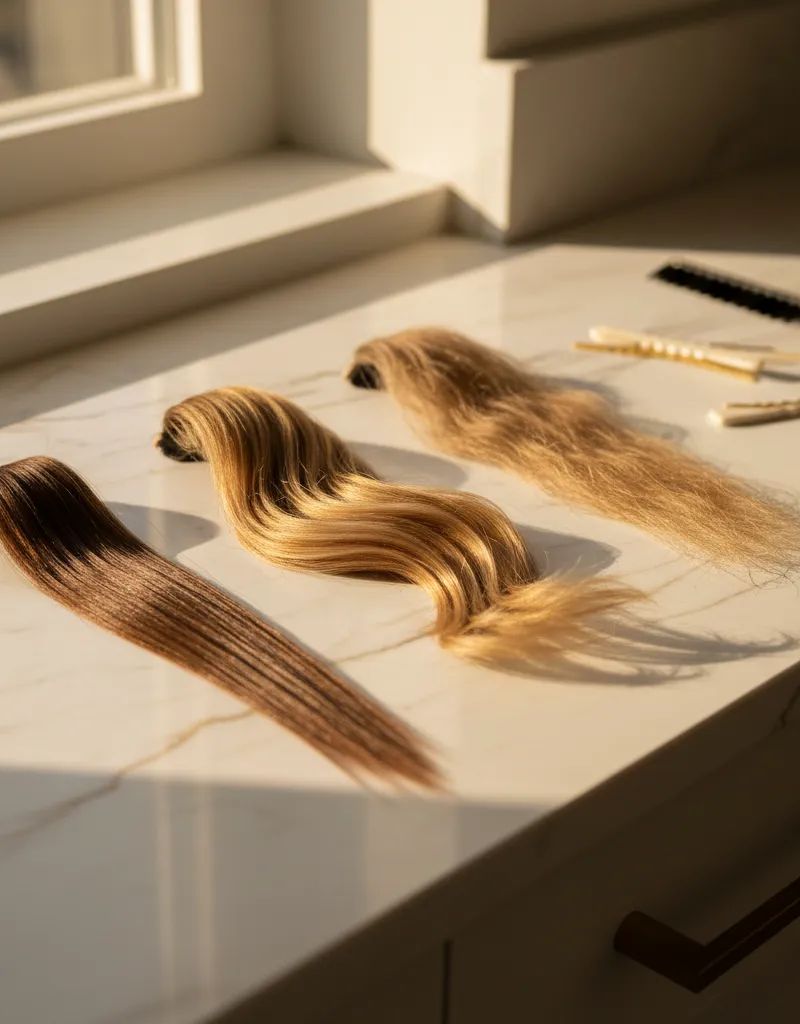
Have you ever applied the same formula to two clients with the same natural level and gotten completely different results?
If you are a professional colorist, this has probably happened more than once. The answer almost always comes down to a factor many overlook: hair porosity.
Porosity determines how each fiber absorbs and retains pigment. Understanding it is just as important as knowing color levels or choosing the right developer volume. Here is how to diagnose it, what it means for your formulation, and how to adjust timing and products for predictable results.
What is hair porosity and why it matters
Hair porosity is the fiber’s ability to absorb and retain moisture and pigment. It depends directly on the condition of the cuticle, the outer layer of the hair shaft made up of overlapping keratin cells arranged like shingles on a roof.
According to the International Association of Trichologists, the cuticle can have between 6 and 10 cell layers. When these layers are closed and compact, the hair has low porosity. When they are lifted or damaged, porosity is high.
This concept is part of the fundamentals of hair colorimetry and directly affects three aspects of your work:
- Absorption speed: How quickly pigment penetrates
- Result uniformity: Whether color distributes evenly
- Color longevity: How long the pigment lasts before fading
The three porosity levels
| Characteristic | Low porosity | Medium porosity | High porosity |
|---|---|---|---|
| Cuticle | Closed, compact | Slightly open | Lifted or damaged |
| Absorption | Slow and resistant | Normal and uniform | Fast and uneven |
| Retention | Excellent once penetrated | Good | Poor, fades quickly |
| Feel | Smooth, may repel water | Flexible, hydrated | Rough, dry, frizzy |
| Common cause | Genetics, virgin hair | Healthy with some processing | Bleaching, heat, chemicals |
Pro tip: A single client’s hair can have different porosity levels across different zones. The ends are almost always more porous than the roots due to accumulated exposure to heat and the environment.
How to test porosity in the salon
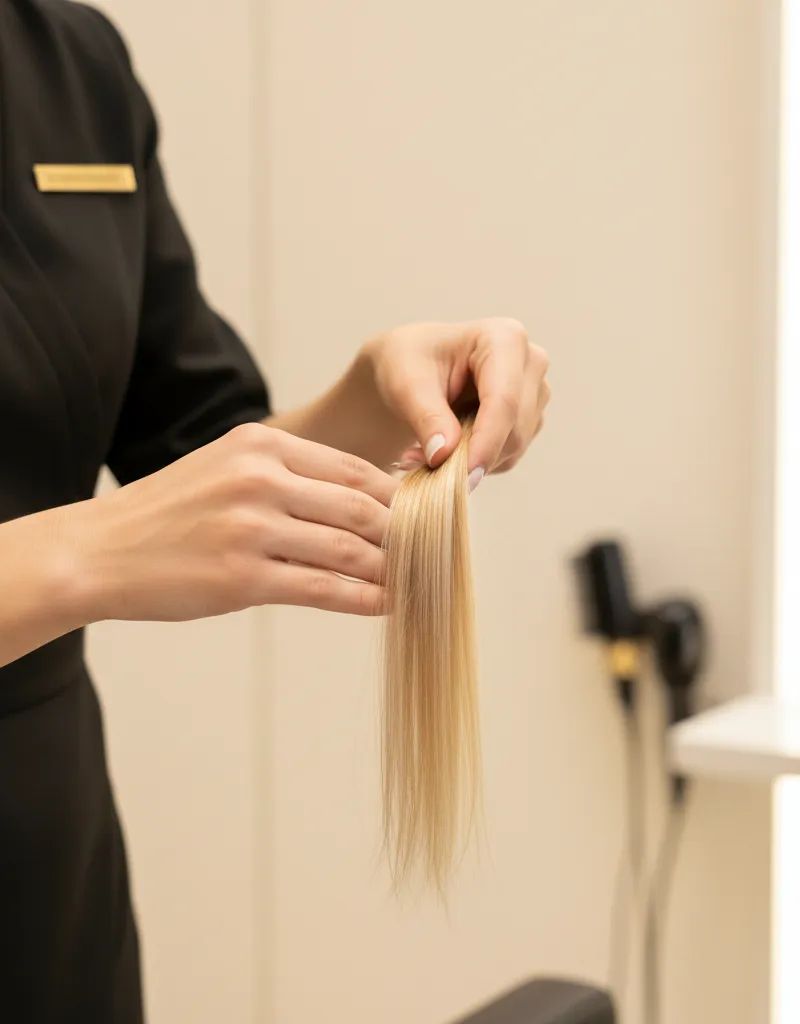
Before formulating, spend 30 seconds assessing porosity. There are three quick methods you can use at your station:
Tactile test (most reliable in the salon)
Slide a strand between your fingers from tip to root:
- Smooth and slippery: Low porosity (closed cuticle)
- Slight texture: Medium porosity
- Rough and bumpy: High porosity (open cuticle)
Water test
Place a clean strand (no product) in a glass of room-temperature water:
| Result | Porosity | Time |
|---|---|---|
| Floats on the surface | Low | Over 4 minutes without sinking |
| Sinks slowly | Medium | 2-4 minutes |
| Sinks quickly | High | Under 2 minutes |
Spray absorption test
Mist water onto a dry strand:
- Drops that slide off: Low porosity
- Gradual absorption: Medium
- Immediate absorption: High porosity
Ideally, combine the tactile test with the spray test. Do not rely on just one.
How to adjust your formulation by porosity
This is where porosity goes from theory to practical tool. Each level requires specific adjustments to developer, timing, and application technique.
Low porosity: the hair that fights back
Low-porosity hair rejects pigment because the cuticle is sealed. The typical result: the color does not cover, comes out lighter than expected, or simply does not penetrate.
Adjustments for low porosity:
- Go up half a level on developer: If you would normally use 20 vol, consider 30 volume to help open the cuticle
- Apply moderate heat: A climazon or hooded dryer at medium temperature helps with opening
- Extend processing time: 5-10 extra minutes beyond your usual timing
- Pre-treatment: A steam treatment can improve receptivity
Medium porosity: your ideal scenario
Medium porosity is the sweet spot. The cuticle is open enough to absorb pigment and intact enough to retain it.
Adjustments: None needed. Formulate according to your usual criteria of level and tone neutralization.
High porosity: fast to absorb, hard to keep
High-porosity hair absorbs pigment almost instantly but releases it just as quickly. This is the most complex scenario because the color can turn out dark, dull, or fade within weeks.
Adjustments for high porosity:
- Lower the developer: Use 10 vol instead of 20. The cuticle is already open, no need for more chemical force
- Fill the gaps: A pre-treatment protein filler partially rebuilds the cuticle
- Reduce processing time: Check every 5 minutes. Porous hair processes faster than expected
- Choose demi-permanent or semi-permanent formulas: Hair glosses work especially well on porous hair because they deposit without aggressing
- Apply mid-lengths to ends last: The most damaged zones need less time. Apply the roots first and leave the ends for last
| Adjustment | Low porosity | Medium porosity | High porosity |
|---|---|---|---|
| Developer | Go up half level (e.g. 30 vol) | Standard (e.g. 20 vol) | Go down (e.g. 10 vol) |
| Time | +5-10 min | Standard | -5-10 min, monitor |
| Pre-treatment | Steam or heat | Not needed | Protein filler |
| Color type | Permanent works well | Any | Demi or semi-permanent |
| Application order | Root to ends | Root to ends | Roots first, ends last |
Porosity and gray coverage: a special case
Gray hair has a peculiarity that puzzles many colorists: it resists pigment despite having an altered cuticle.
Gray hair loses melanin but maintains a compact and rigid cuticle, creating a scenario of functional low porosity. This explains why grays resist coverage even when the surrounding hair (chemically processed) absorbs without issue.
Solution: Treat grays as low-porosity hair. Use a minimum of 20 vol developer, extend processing time, and consider a pre-softening with developer alone for 5 minutes before applying the full formula.
Common mistakes when working with porosity
- Ignoring variable porosity: Applying the same formula from root to tip without evaluating the differences. The ends are almost always more porous than the roots
- Using high developer on porous hair: If the cuticle is already open, a strong developer only causes more damage without improving the result. Review your developer options
- Skipping the filler step: Not filling before coloring bleached or heavily processed hair. Without filling, pigment goes in and comes out equally fast
- Relying only on the water test: The glass test can give false positives if the hair has product on it. Always combine with the tactile test
Frequently asked questions
Can you change hair porosity?
Not permanently. Protein and keratin treatments can temporarily close the cuticle (4-6 weeks), but newly grown hair retains its genetic porosity. What you can do is avoid increasing it with aggressive practices.
What porosity does bleached hair have?
High porosity in the vast majority of cases. Bleaching removes melanin and damages the cuticle, significantly increasing porosity. The more bleaching sessions, the higher the porosity.
Is curly hair always high porosity?
Not necessarily. Virgin curly hair can have low or medium porosity. What happens is that the spiral shape makes the cuticle more irregular, which can be confused with high porosity. Always assess with the tactile test.
How often should I evaluate a client’s porosity?
At every visit. Porosity changes with chemical treatments, heat use, and home care. A client who had medium porosity three months ago may have shifted to high if they have been using flat irons daily.
Key takeaways
- Porosity determines how hair absorbs and retains pigment
- Three levels: low (resists), medium (ideal), and high (absorbs fast, releases fast)
- Tactile + spray test: the most reliable combination in the salon
- Always adjust developer, timing, and pre-treatment based on porosity
- Gray hair behaves like low porosity even when it appears damaged
Calculate professional formulas with AI
Want to generate personalized formulas that account for each client’s hair condition, including porosity, chemical history, and starting level?
Try Blendsor free - 5 formulas per month, no credit card required.
Related articles

Practice with our free tools
Calculators, neutralization wheel, AI consultation...
Apply this theory with precision
Blendsor analyzes 70+ variables and generates exact formulas based on real colorimetry. Try our free color consultation or download the app.
Download free