Why Hair Color Fades Unevenly (And What to Say)
Color doesn't fade the same way across your whole head. Light reaches some spots more than others, not in a fixed order. Here's the timing detail worth bringing to your next appointment.
Blendsor
Blendsor Team
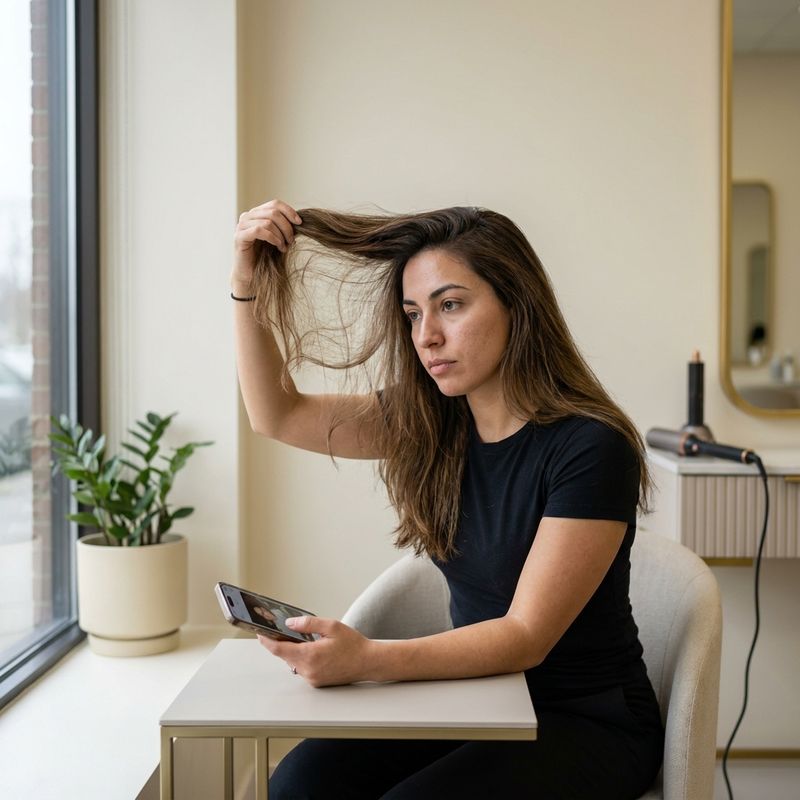
You don’t need to walk into your appointment knowing the name of your shade. You need one piece of information only you have: how long the color held up before it started to change, and where you noticed it first. Your colorist can see exactly how your hair looks today. What they can’t see is the road it took to get there.
Quick summary: hair color doesn’t fade evenly across the whole head. Light breaks it down through photodegradation, and very high heat, like a flat iron’s, can change the hair’s own color by a different route. Neither exposure hits every part of your hair the same way. There’s no fixed order that applies to everyone. What does help is a detail only you can give: how long it held up, and where you noticed the change first.
Ever shown up to an appointment with the photo from the day you left the salon, held it up against your hair today, and had no idea where to even start explaining what changed?
It’s not that you’re missing the technical vocabulary. It’s that you’re asking your memory to hold onto something it’s bad at keeping: the order things happened in. And that order, as unlikely as it sounds, is useful information for whoever’s about to touch up your color.
Why doesn’t color fade the same way everywhere?
Because there isn’t one force acting on your hair — there are two, and neither one spreads its effect evenly. Light hits the parts left exposed hardest: the crown, the part line, any strands that fall outside a ponytail or a scarf. Heat only reaches wherever you pass the dryer or the flat iron, and very high heat, like a flat iron’s, can change the hair’s own color. Two different exposures, two different maps, and on top of that, everyone lives differently: someone who works outdoors doesn’t expose their hair the way someone at a desk all day does, and someone who blow-dries daily treats it differently than someone who lets it air-dry half the time.
That’s why there’s no anatomical order that repeats the same way on every head — “it always shows up in front first” isn’t a rule, it’s one possibility among several. What is constant is the mechanism: more real exposure, more wear. The practical result is that the map of how your color faded is yours, and it might not match the person sitting in the chair next to you — it’s not a pattern your colorist can guess ahead of time.
What does light actually do to color?
It fades it through photodegradation: radiation breaks down the structure of the artificial pigment and the color loses intensity, a process separate from and additional to what plain washing already takes. A study published in the Journal of Cosmetic Science (Locke & Jachowicz, 2005) exposed copper-toned dyed hair swatches to simulated radiation for 16 to 48 hours along with periodic washing, and measured that color loss was greater when a swatch got both exposures at once — light and washing — than when it only got one.
Translated to real life: hair that gets more sun and is also washed at a normal frequency loses color faster than hair that gets only one of those two things. You don’t need to sunbathe for it to count — wearing your hair down and uncovered on short trips, on terraces, or simply living somewhere sunny most of the year is enough.

The spot that gets the most sun isn’t the same for everyone.
And what does heat do?
It changes the color of the hair fiber through a different route, and part of that has been measured. A study in the Journal of Cosmetic Science (Nogueira et al., 2004) placed undyed, virgin hair on a hot plate at 172°C and recorded a significant darkening with a spectrophotometer after just two minutes. The same study exposed hair to the gentler heat of a hand dryer, around 60°C, for an hour: part of the fiber’s inner core disappeared, but the color difference stayed close to the error limit of the measurement.
Keep the study’s limits in mind. The hair wasn’t colored, so it shows that high temperature can change the fiber’s own color. It doesn’t show whether a flat iron or a dryer fades a dye, or where on the head that would show first. And a flat iron moves along your hair rather than sitting on one spot for two minutes.
Correction, 13 September 2026: an earlier version of this section said the study used dyed hair and that the blow-dryer produced a measurable color change. It used undyed hair, and the dryer’s color difference was close to the error limit of the measurement. The journal, year and author name in the citation have also been corrected. We also removed the FAQ advice to let hair air-dry, because another study found that air-dried hair changed color too, and we adjusted the lines that presented heat as a proven cause of dye fading.
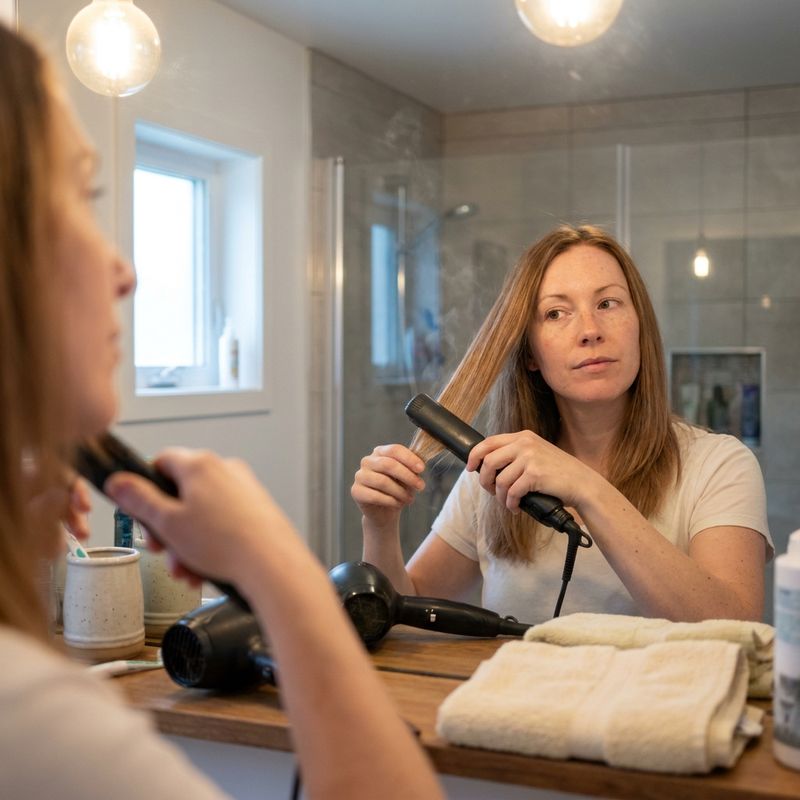
Heat concentrates wherever the tool passes most, not evenly across the whole head.
Pro tip: if your color faded faster this time than last time, before assuming the formula was off, think back over your routine those months. A summer with more sun than the last one can explain the change, and it’s exactly the detail worth mentioning at your appointment, along with whether you used the flat iron more.
Why is this different from lift, which doesn’t come back?
Because we’re talking about tone here — the shade deposited on top of the lightened base — and that deposit has a way out: through light and through washing. Lift, what the lightening process raised inside the fiber, doesn’t work that way: it’s a structural change that doesn’t reverse on its own. We covered that in detail in another article: what breaks down inside the fiber during lightening, and why only tone has a mechanism for leaving. This article goes one step earlier: where and when that fading tone actually starts to show, and what to do with that information once you’re in the chair.
The detail only you have: how long it held up
Your colorist can see exactly how your hair looks today — whether the tone’s still intact, whether something’s peeking through underneath, whether the shine has dropped. What they can’t see is the path: how many weeks passed before you noticed it, and whether the change hit all at once or crept in gradually. We already covered what to report, and in what order, when color seems to be fading — what was done, what you’ve used since, specific photos. This article adds the piece that was missing there: time.
You don’t need calendar-level precision. “It held up fine for about a month, then dropped off fast” works just as well as “it started fading almost from week two.” What matters is the shape of the curve — slow and steady, or stable and then a drop — because each shape points to a different cause: a slow, even loss usually means normal washing and routine; a sharp drop on a specific stretch of time usually lines up with a trip, a season change, or a run of more heat styling than usual.
| What you report | What it usually points to |
|---|---|
| Faded gradually, evenly | Normal wear from washing and routine |
| Dropped suddenly after a trip or vacation | Sun exposure outside the usual routine |
| Shows more at the ends than the roots | Ends are older than the roots and carry more past color and wear |
| Held up less than last time with the same formula | Something changed in your routine, not the formula |
What to say at your appointment, and in what order
Four details, in this order, so the full story comes across without your colorist having to ask one question at a time:
- How long it held up well before you noticed the first change, even roughly.
- Whether the change was gradual or sudden, and whether it lined up with anything specific — a vacation, a change in styling routine, a stretch of more heat.
- Where you noticed it first — ends, roots, one side — if there’s a spot that stood out from the rest.
- What you’ve done since the service: daily blow-drying vs. air-drying, flat iron use, a hat or sun protection, purple shampoo.
With those four details, your colorist doesn’t have to guess between light, heat, or normal washing — they can tell them apart from what you tell them, and decide whether that means a full gloss, a targeted touch-up on the spot that moved most, or just sticking to the regular schedule.
Frequently asked questions
Is there an order that’s the same for everyone?
No. Light causes more fading wherever there’s more real exposure, and that exposure depends on your own routine and daily life, not a fixed anatomical rule. That’s why the useful detail isn’t “this is how it always goes” — it’s “this is how it went for you.”
Does purple shampoo affect what I should say about timing?
Yes, and it’s worth separating the two. Purple shampoo pigment reads as part of your color while you’re using it, so if you applied it in the days right before you noticed a change, mention that — it may be masking or exaggerating what you’re seeing, not the underlying cause.
Can I stop heat from affecting my color?
We haven’t found a study that measures how much dye a flat iron or a dryer takes out, so there’s no number to promise you. What has been measured, on undyed hair, is that very high heat darkened the fiber significantly, while gentle dryer heat left a color difference close to the error limit. So the sensible move is not to use your flat iron hotter than your hair needs and not to go over the same section again and again. And tell your colorist how often you use each tool: that’s part of the detail too.
What if I don’t notice any spot that’s more faded than the rest?
That’s a useful answer too — “it faded evenly, no spot is worse” tells your colorist something just as much as the opposite would. It makes a cause concentrated in one spot, like more sun on one side, less likely, and points more toward general wear from washing and time.
In summary
- Hair color doesn’t fade evenly across the whole head: light and heat act by zone, based on real exposure, not a fixed order.
- Light fades it through photodegradation, and the effect is stronger when combined with regular washing.
- Heat can change hair color through a separate route: brief, intense heat significantly darkened undyed hair in a lab study, while gentler dryer heat left a difference close to the measurement’s error limit.
- The missing piece is time: how long it held up, and whether the change was gradual or sudden — only you have that.
- Bring it to your appointment in order: how long it held up, gradual or sudden, where you noticed it first, and what you’ve done since the service.
Before your next appointment
If you also want to see how a new shade would look before deciding, Blendsor’s color simulator tries it on your own photo.
Why does hair color fade in a specific order?
In the app, we ask you a question like this one, but about your own client.
Up for this week’s case? → More on global color →Related articles

Practice with our colorimetry tools
Calculators, neutralization wheel, AI consultation...
The Blendsor newsletter
Color techniques and trends for professionals. No spam.
You know the theory. What about today's case?
Send a photo to the Blendsor advisor and get an answer grounded in colour theory: toner, developer and timing, with the brands on your shelf.
Ask about your caseWritten by the Blendsor team
Professional hair colorimetry experts with experience in AI-assisted formulation. We combine color science, salon practice and technology to help colorists formulate with precision.