Why Hair Color Turns Out Different the Second Time
The mixing ratio isn't set by the brand — it's set by the product line. What changes between lines, and what to log on the card so it's repeatable.
Blendsor
Blendsor Team
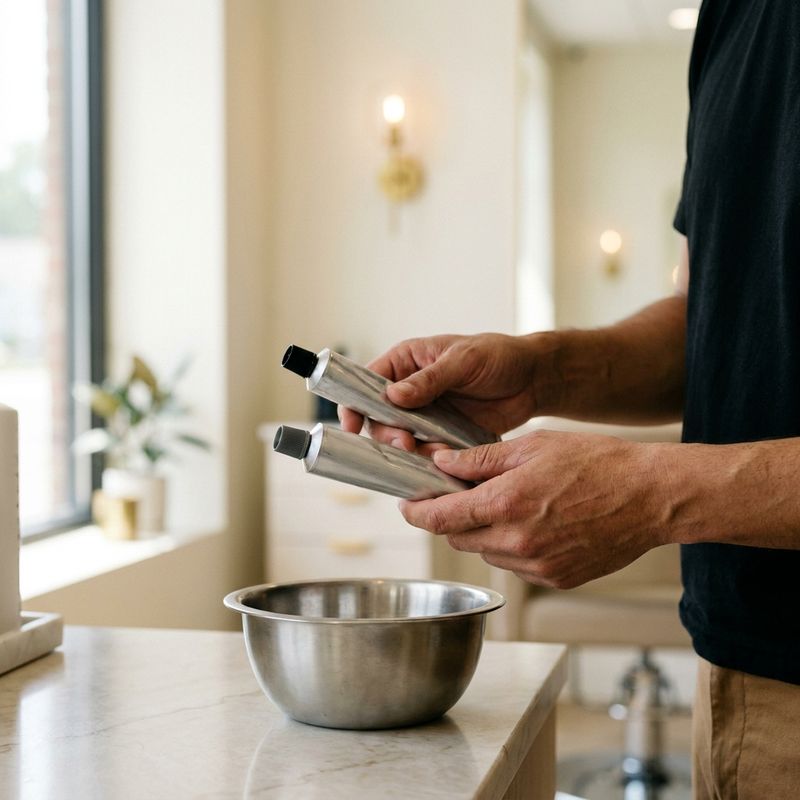
Have you ever grabbed the tube you always grab, from the brand you always trust, and the result wasn’t the one you always get?
It happens more than you’d think. The person in your chair asks for a little more lift than last time. You go to the same shelf, pick up a tube from the same house you’ve been using for months, mix it at the ratio your hands already know by heart, and the lift comes up short. You didn’t switch brands. You switched lines within the brand, and that line doesn’t mix the same way.
Quick summary: the developer ratio isn’t set by the brand, it’s set by the product line. Different lines from the same house can run on different protocols: L’Oréal Professionnel mixes its standard Majirel at 1:1.5 with 20- or 30-volume developer, and its maximum-lift line — Majirel High Lift — at 1:2 with 30- or 40-volume. Applying the standard line’s ratio to the high-lift line doesn’t break anything, it just falls short: less developer than that line needs delivers less lift than promised. The detail that prevents the misfire isn’t “which brand I used,” it’s “which line I used, at what ratio” — and that’s exactly the field most client cards leave blank.
Why doesn’t the same brand guarantee the same ratio?
Because a professional color brand doesn’t sell one product — it sells several lines built for different jobs, and each line carries its own tint-to-developer relationship in its technical sheet. Trusting the brand because “you know it” is exactly the blind spot: you know it through its standard line, the one you reach for most of the time, and that familiarity doesn’t automatically transfer to a line you’re picking up for the first time today.
It’s a documented pattern even inside a single house. L’Oréal Professionnel’s Majirel usage chart lists one protocol for its standard line — Majirel, Majirel Cool Inforced and Majirouge — and a different one for its maximum-lift line — Majirel High Lift. Same manufacturer, same shelf, two different mixes.
| Line | Ratio | Developer | Purpose |
|---|---|---|---|
| Majirel, Majirel Cool Inforced, Majirouge | 1:1.5 | 20- or 30-vol | Standard color and coverage |
| Majirel High Lift | 1:2 | 30- or 40-vol | Maximum lift |
Within that range, the volume chosen splits the goal between lift and neutralizing the warm undertone: more volume favors lift, less volume favors neutralization. These numbers come from the manufacturer’s technical sheet, not an industry average — every house structures its lines its own way, so what holds for Majirel doesn’t carry over to another brand without checking. What does carry over is the habit of checking the specific line’s sheet before mixing, not the brand’s in general.
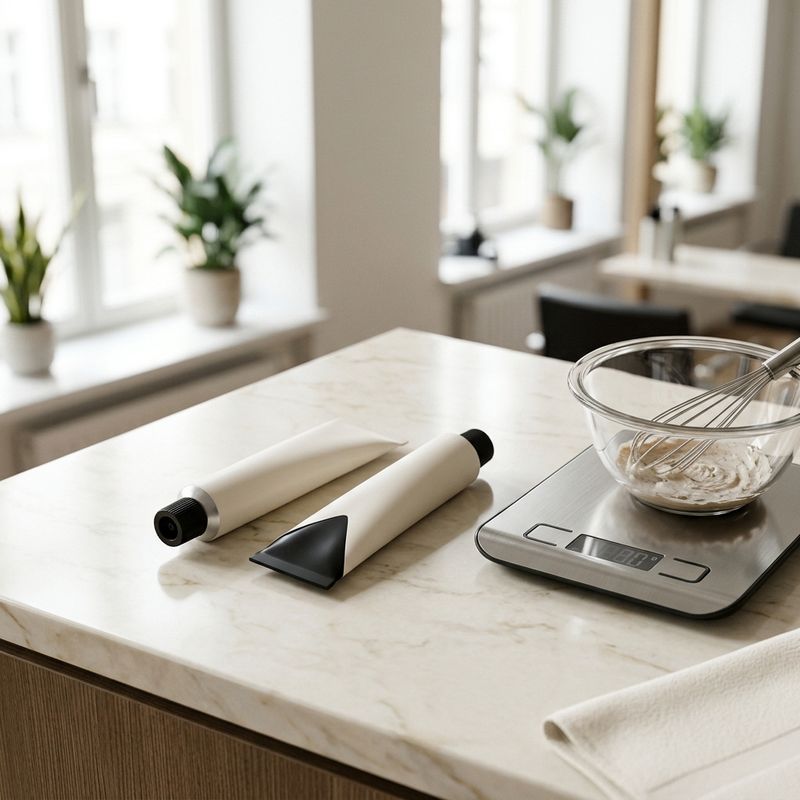
What happens if you mix the new line at your usual ratio?
The most common symptom is a lift that falls short: less developer relative to the tint than that line needs to deliver on its promise. The reaction isn’t wrong, it’s incomplete. The maximum-lift line is formulated to work with proportionally more developer — 1:2 instead of 1:1.5 — precisely because its job is to lift more levels, not just deposit color. If you apply the thinner mix you’re used to, thinking “same house, same logic applies,” the result lands below what the person in the chair expected, and below what you expected from the tube in your hand.
There’s a second, less visible consequence: mix consistency. A 1:2 ratio produces a thinner mix than a 1:1.5 with the same amount of tint. Prepare the maximum-lift line as if it were the standard one, and the mix comes out denser than that technique needs to saturate the fiber evenly — and a mix that’s too dense where it needed to be thin makes even application harder, especially in foiled or paper-wrapped lightening work.
Pro tip: before mixing, check the full name on the tube, not just the brand. “Majirel” and “Majirel High Lift” share a manufacturer, but they don’t share a technical sheet.
Why does this trip people up on the second visit, not the first?
Because on the first visit, everything is new: you read the technical sheet because you don’t have any prior muscle memory with that brand. The risk shows up once you already have confidence with the house — once your hand already “knows” how that brand mixes in general — and you pick up a different line from the same brand without repeating the check-the-sheet gesture, because the standard line’s autopilot is already switched on.
It’s the same mechanism we cover in what to record after a color correction: today’s color sets up the one six weeks from now, and what usually fails isn’t the day’s formula — it’s the detail nobody wrote down for next time. Here, the missing detail isn’t the fiber’s underlying pigment — it’s the exact product line that was used, with its ratio and developer, not just the brand name.
What to log on the card so the second visit doesn’t rely on memory
Three details per service, not one:
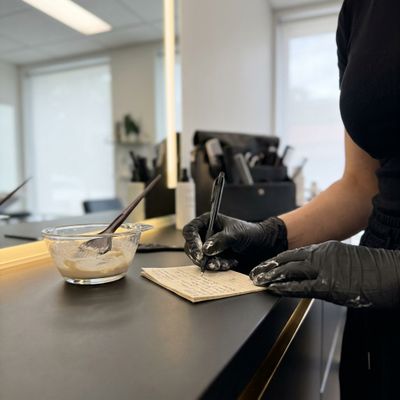
- The exact line, full name. “Majirel” alone doesn’t tell the next colorist whether to replicate 1:1.5 or 1:2. “Majirel High Lift” does.
- The ratio used, next to the line name. If the developer volume varied within the allowed range (20 or 30, 30 or 40), note which one you chose and why.
- The reason that line was chosen: extra lift, standard coverage, toning? That reason is what decides whether next visit repeats the same line or switches to another one again.
Compare these two notes for the same service:
- Poor card: “Majirel 7.1 + 8.1, 30-vol developer.”
- Useful card: “Majirel High Lift 7.1 + 8.1 at 1:2, 30-vol developer (base 7, goal: extra lift + neutralization).”
The second one doesn’t take longer to write. It just takes the habit of noting the full line, not only the color code, whenever the tube isn’t your default one.

This log is different from what we already cover in how much hair dye do I need — that guide gives the starting quantity by length and service — and in mixing hair dye ratios — that one explains what each ratio means in general. Here the focus is narrower: what breaks when two lines from the same brand live side by side on your station, and the log doesn’t tell them apart.
Common mistakes when switching lines within the same brand
- Assuming “knowing the brand” means knowing its whole catalog of lines. Familiarity with the standard line doesn’t automatically include the maximum-lift line, the mixer line, or the toning line. Each one has its own sheet.
- Logging only the brand’s short name on the card. “Majirel” alone leaves out the information that decides the ratio next time.
- Turning up the developer instead of switching lines. If you need more lift than the standard line delivers, the fix isn’t forcing a higher volume on a product built for a different ratio — it’s moving to the line designed for that goal, with its own protocol.
- Not checking the person’s goal before choosing a line. The goal — coverage, extra lift, toning — is what determines which line is right, not the habit of always reaching for the same tube.
Frequently asked questions
Does every brand structure its lines with the same ratio logic?
No. Each house decides its own line structure and its own ratios. The Majirel case — standard at 1:1.5, maximum lift at 1:2, both from L’Oréal Professionnel — illustrates the mechanism, but every manufacturer has its own chart. Before mixing a line you rarely use, check its specific technical sheet.
How do I know if a tube belongs to the standard line or the maximum-lift line?
By the full name printed on the tube and the box, not just the brand logo. Maximum-lift lines often carry terms like “High Lift,” “Ultra,” or “Ultimate” in the name — but the exact wording varies by manufacturer, so the specific product’s technical sheet is the final reference.
If I switch lines within the same brand, does the processing time change too?
Yes, each line carries its own timing in the manufacturer’s technical sheet, along with its own ratio and developer range. Same as with the ratio, don’t assume the timing of the line you use most often: confirm it in the sheet for the specific line in your hand.
Why isn’t logging the color code on the card enough?
Because the color code describes the tone, not the ratio or the developer it was mixed with. Two different lines from the same brand can share a color code and mix in completely different ways. Without the line noted next to the code, the next visit repeats the correct tone with the wrong mix.
In summary
- The line decides the ratio, not the brand. Two lines from the same house can mix in different ways.
- Standard Majirel mixes at 1:1.5 with 20- or 30-vol developer; Majirel High Lift mixes at 1:2 with 30- or 40-vol, per L’Oréal Professionnel’s technical sheet.
- Applying your usual ratio to a new line falls short: less developer than needed delivers less lift than promised.
- The blind spot shows up on the second visit, once you already trust the brand but switch lines without repeating the check-the-sheet gesture.
- Log the full line next to the ratio on the card, not just the brand’s short name: that’s what keeps the next visit from relying on memory.
Calculate formulas by product line with AI
Want to log the exact line used in each service — not just the brand — and calculate the correct ratio and developer for each client’s goal?
How many different lines are sitting on your station right now, and how many are logged on the card with their ratio?
Why doesn't the same dye come out the same the second time?
In the app, we ask you a question like this one, but about your own client.
Up for this week’s case? → More on global color →Related articles
Practice with our colorimetry tools
Calculators, neutralization wheel, AI consultation...
The Blendsor newsletter
Color techniques and trends for professionals. No spam.
A client in the chair right now?
The Blendsor advisor gives you the precise formula for this technique with your salon's brands — and saves it to your client's card.
Ask about your caseWritten by the Blendsor team
Professional hair colorimetry experts with experience in AI-assisted formulation. We combine color science, salon practice and technology to help colorists formulate with precision.