Yellowing Gray Hair: How to Neutralize It Without Guessing
How to neutralize yellowing gray hair with violet, the opposite of yellow, and what to check first: where it sits, the hair's history, what they want.
Blendsor
Blendsor Team
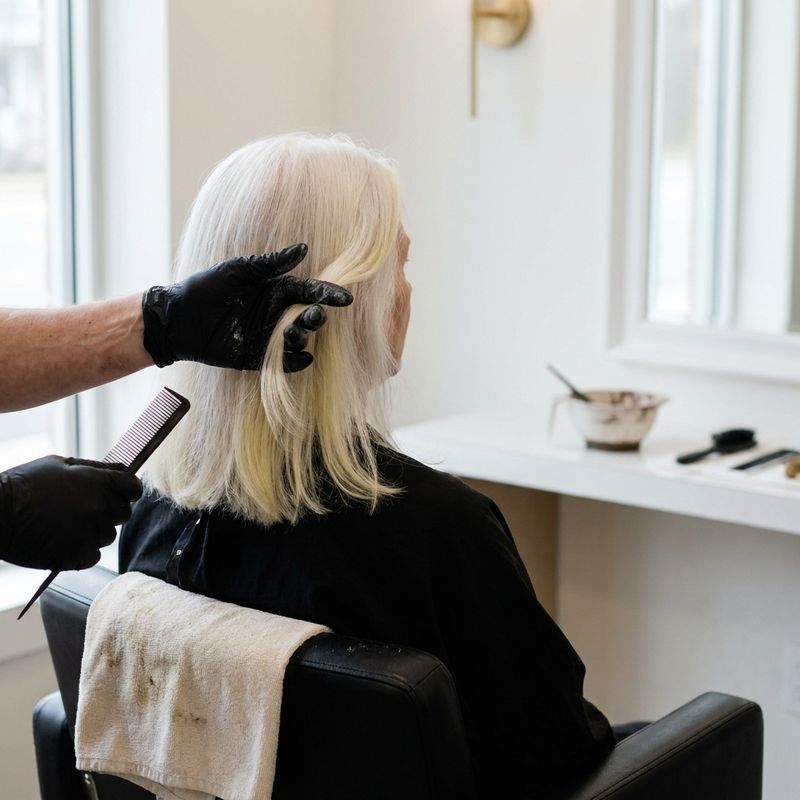
The person sits down, points at a strand by their face and asks if that can come out. You see white hair with a yellow cast. What you’re holding is a decision with a trap in it: the silver shade on the shelf looks like the gentle way out, and a low developer number makes it feel safe.
This piece is about what you ask and what you look at before you neutralize yellowing gray hair, and about what a brand’s chart says when you read all of it instead of only the number you came for.
Quick summary: yellow is neutralized with its opposite on the color wheel, violet, and on white hair the yellow may soften, though it’s not worth promising. Before you neutralize yellowing white hair, look at where the yellow sits, what the hair has been through and what the person expects to see. A silver shade that mixes with developer is still oxidation color even at 3%: allergy test first, and at the very least not on the day of the color appointment. And the developer number doesn’t tell the whole story: on Igora Royal’s US wall chart, the same 3% is also listed for covering 100% of white hair.
How do you neutralize yellowing gray hair?
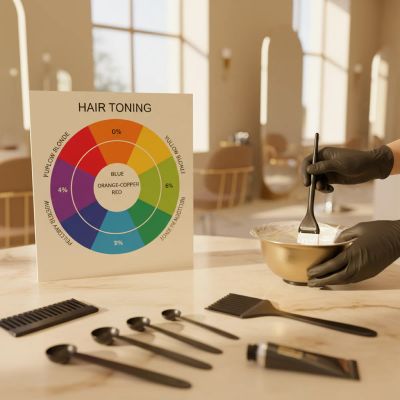
Yellow is neutralized with its opposite on the color wheel, violet. Wella draws it in its Koleston Perfect usage guidelines: a complementary color wheel with yellow and violet facing each other, and the line “Opposite colors neutralise one another”. With a well-chosen violet the yellow may soften; on white hair, check it on a strand before taking it for granted.
Which violet shade to use in each brand, and how it’s built on lightened blonde, is in how to neutralize unwanted tones. And when gray comes in dull or with a yellowish cast during a transition, stopping gray hair color treats it as between-appointment work. If you reach for a silver shade on that white hair, check its chart for the tone it carries: violet is what works against yellow. What changes on white hair is what happens before the bowl.
What do you check before neutralizing yellowing gray hair?
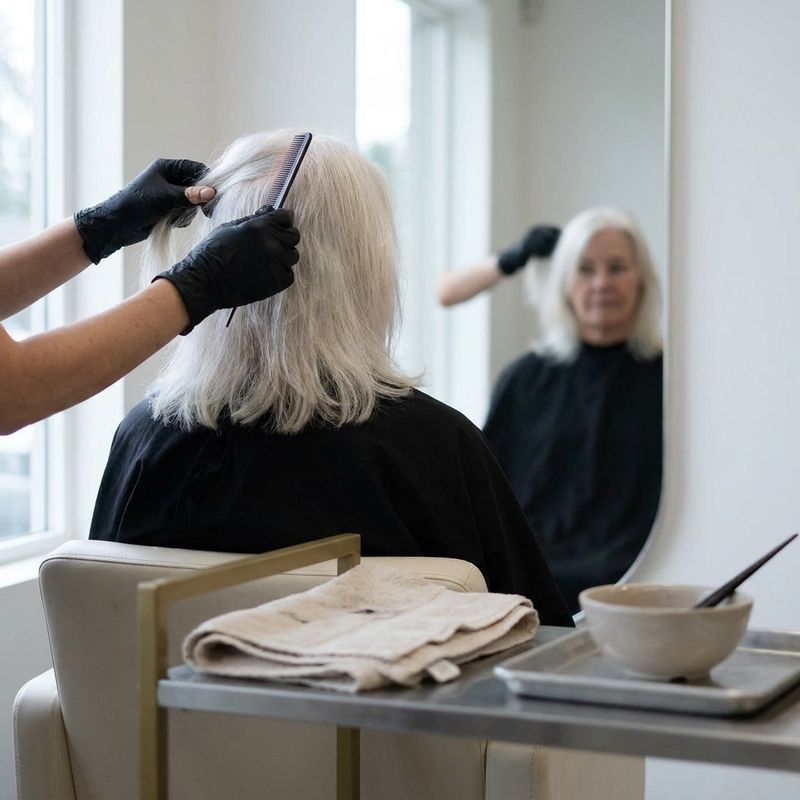
Four things come before the product: where the yellow is, what the hair has been through, how long the person has been seeing it and what they expect to walk out with. Check with dry hair in daylight and you stop choosing blind.
| What you look at | Why it changes the decision |
|---|---|
| Where the yellow is | At the ends, beside the face or all through the length, it isn’t handled the same way: sometimes you only need to touch the lengths and the face frame, not the whole head. |
| What the hair has been through | Previous color, lightening, toners. The history of the lengths decides what that hair tolerates. |
| How long the person has seen it | If they’re growing out their color, the lengths may still carry traces of the old shade. |
| What they expect to see | A cleaner white, a natural gray or a root that doesn’t show call for different services. |
Is the yellow in the white itself, or a leftover from the transition?
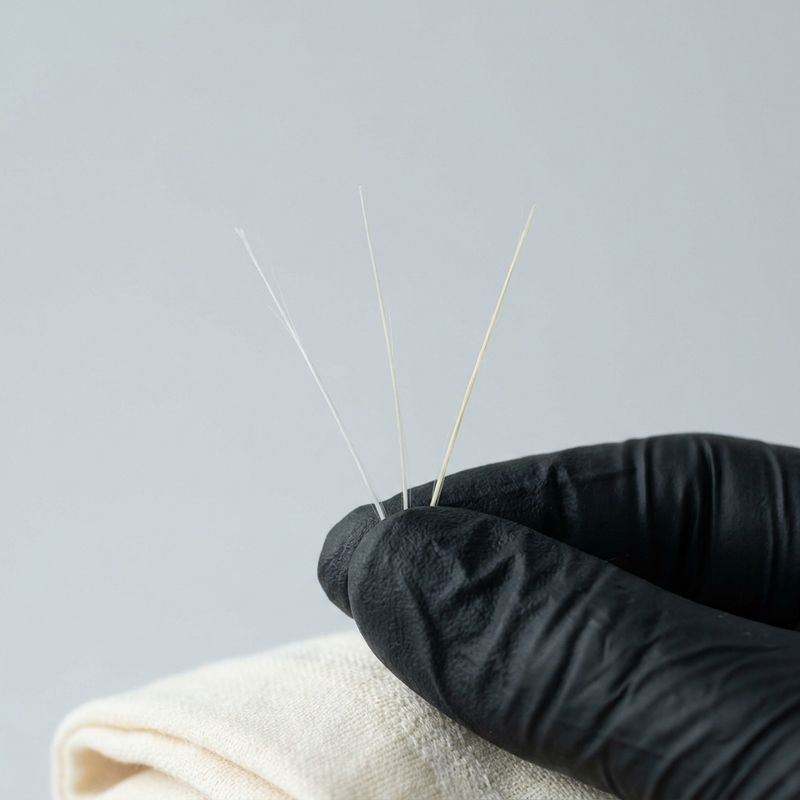
That’s the question to answer before mixing anything, and you answer it with the hair’s history, not only with your eyes. When someone stops coloring and a dark shade is taken out of the lengths, with a color remover or lightener, a warm base may be left showing that then needs toning (it’s covered in stopping gray hair color, step by step). If the yellow appears on white hair that has gone a long time without color, the question changes: what have those lengths been through?
Without a history there’s no cause to state. You note what you see, run a strand test and decide with what the hair answers.
What is this person after with their gray?
That question decides the service, and it’s worth asking out loud before you open a tube. Three possible answers, three different decisions:
| What they say | What they may be asking for | What you decide |
|---|---|---|
| ”I don’t want the yellow to show” | A white that looks cleaner | What exactly they expect to see, and whether they’d rather test a strand first |
| ”I don’t want it to look dyed” | A natural gray, without a strong silver | Whether to cancel the yellow or leave it. Blending the gray into the color is a different route: Quiet Silver |
| ”I don’t want the root to show” | Coverage, not neutralizing | A different service: see the gray coverage levels |
The same sentence (“that looks yellow”) can hide any of the three. Asking takes a minute; redoing a service takes an appointment.
Why does a silver shade look like the gentle option?
Because the developer number sounds small. With yellowing white hair, the silver shade is the first thing that comes to hand, and it’s worth reading its whole chart before calling it handled.
One example with manufacturer figures: on Igora Royal’s US wall chart, IGORA ROYAL Silver Whites goes 1:1, is recommended with 3% (10 vol) and has an exposure time of up to 20 minutes. Those 20 minutes are the maximum.
It runs at 3%, but it’s oxidation color: you mix it with developer. That’s why an allergy test beforehand is worth doing, at the very least not on the day of the color appointment.
What does the 3% say when you read the whole thing?
Don’t look only at the number. In the oil developer usage guide on Igora Royal’s US wall chart, the 3% (10 vol) is listed under “Coloring darker hair” and “Covering 100% white hair”, and the 6% (20 vol) under “Coverage on white hair”.
The same volume shows up in services that look nothing alike, so the developer doesn’t tell you what will happen: the product, its range and its chart do. Each brand, and sometimes each country, sets its own limit: check your manual.
And if what the person wants from their gray isn’t to cover it, the volume is only part of the answer. The other part is the question from before.
What do you tell the person before you mix?
Three sentences worth having ready:
- What you see. “I see a yellow cast here and here, and I don’t know yet where it comes from.” You describe what’s visible, without a cause you can’t check.
- What happens first. A strand test and, if the service involves color, the allergy test on another day, not the day of the color appointment.
- What you don’t promise. You don’t promise to remove the yellow; you promise what you check on the strand and to look again with the person afterwards.
Common mistakes with yellowing gray hair
- Choosing the product by the developer number. The 3% appears in very different services; the number doesn’t replace the range’s chart.
- Taking for granted where the yellow comes from. Without the hair’s history it’s a hypothesis. Say so.
- Promising the yellow will go. It’s the sentence that costs you most when the strand answers something else.
- Booking the allergy test and the color on the same day. The test goes before the color appointment.
Frequently asked questions
How do I neutralize yellowing gray hair?
With the opposite of yellow, violet, and first with a decision: what the person expects to see and where the yellow may come from, using the hair’s history. How to neutralize unwanted tones explains how it’s built. Before doing the whole head, test on a strand: the yellow may soften, and you don’t promise it.
What developer does a silver shade take?
It depends on the brand and the range. In the Igora Royal Silver Whites example, 1:1 with 3% (10 vol) and up to 20 minutes, which is a ceiling. Check the manual for yours.
Does a silver shade need an allergy test?
If it mixes with developer, it’s oxidation color: allergy test before the color appointment, and at the very least not the same day.
Can you promise to remove the yellow from gray hair?
No. What you can promise is what you do: look at the strand, decide with the person what they expect to see and look again afterwards.
Summary
- Yellow is neutralized with its opposite, violet; on white hair it may soften, and you check it on a strand before promising it.
- Look at where the yellow is, what the hair has been through and what the person expects to see before choosing a product.
- The question that decides the service: what is this person after with their gray?
- A silver shade that mixes with developer is oxidation color even at 3%: allergy test first, not on the day of the color appointment.
- The developer number doesn’t tell the whole story: read the range’s chart and your brand’s manual.
- What you promise is to look at the strand with the person, before and after.
Calculate professional formulas with AI
Want to formulate the mix from the starting level, the gray percentage and what each person’s hair has been through?
When someone shows you white hair with a yellow cast, what’s the first thing you ask?
Manufacturer sources
Manufacturer documents consulted for this article. A copy of each one is kept, and the passages noted from it are checked against that copy.
Note each one's country: the same line's instructions can differ from one market to another, so follow the directions for the product you use.
What do you check and ask before neutralizing yellowing gray hair?
In the app, we ask you a question like this one, but about your own client.
Up for this week’s case? →Related articles
Practice with our colorimetry tools
Calculators, neutralization wheel, AI consultation...
The Blendsor newsletter
Color techniques and trends for professionals. No spam.
You know the theory. What about today's case?
Send a photo to the Blendsor advisor and get an answer grounded in colour theory: toner, developer and timing, with the brands on your shelf.
Ask about your caseWritten by the Blendsor team
Professional hair colorimetry experts with experience in AI-assisted formulation. We combine color science, salon practice and technology to help colorists formulate with precision.