Toner Processing Time by Brand: What Each Page Says
Toner processing time by brand: Dia Light, Igora Vibrance and Shades EQ don't ask for the same minutes. What each US and UK page says, and what it leaves out.
Blendsor
Blendsor Team
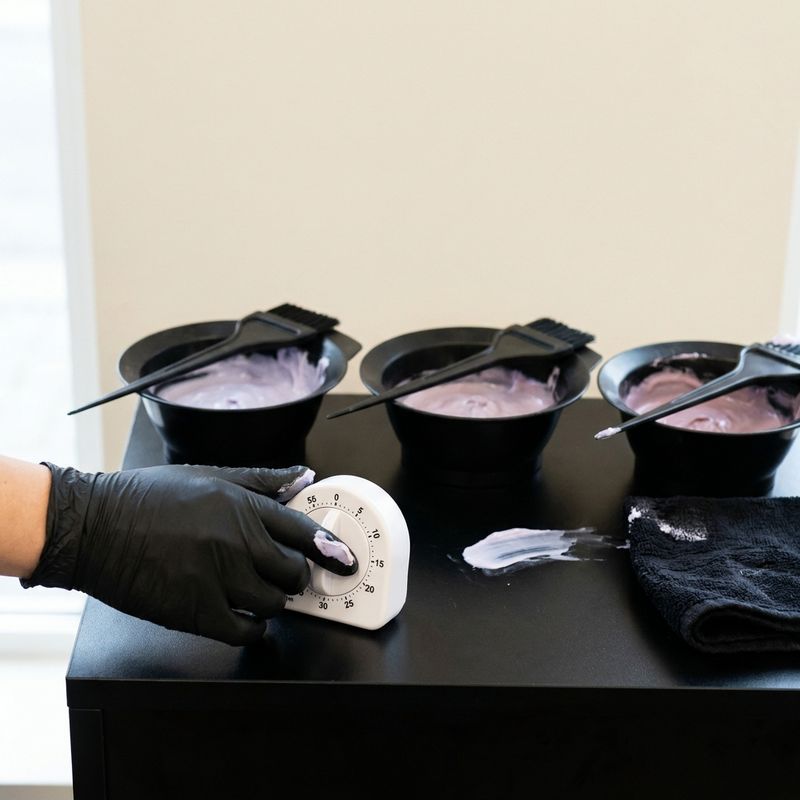
Whose minutes are on your timer when you mix a toner?
With several toner lines on the shelf, it’s easy for the timer to keep the previous bowl’s minutes. And there’s no reason for them to carry over: the US and UK pages for Dia Light, Igora Vibrance and Shades EQ don’t ask for the same thing, and they don’t even count time the same way.
Here is what each one says, what it leaves out, and how to set things up so the clock follows the product in the bowl. If you want a refresher on how bases and tones read first, start with the colorimetry basics guide. The full gloss technique, with the mix and the application for each line, is in the hair gloss guide; the question here is just this: how many minutes each page gives, and what those minutes refer to.
About the sources: every figure here comes from the manufacturer’s own US or UK page, or from the English-language edition (UK spelling, edition code 0124) of Schwarzkopf Professional’s Igora Vibrance technical manual, consulted on October 7, 2026. Where the US and UK pages differ, both are given. The instructions in your box may differ, and those are what you follow.
Quick summary: there is no single processing time for toner. Dia Light gives 2 to 20 minutes on its US page, Igora Vibrance says up to 20 minutes on its US and UK pages, and Shades EQ says 20 minutes, up to 40 for gray hair, on its US and UK pages. The product in the bowl sets the timer.
How long do you leave toner on, by brand?
It depends on the brand, the line and what the page ties the time to. Dia Light (L’Oréal Professionnel, US) gives 2 to 20 minutes for the whole line. Igora Vibrance (Schwarzkopf Professional, US and UK) says up to 20 minutes, with a range for each service. Shades EQ (Redken, US and UK) says 20 minutes at room temperature, up to 40 minutes for gray hair.
| Toner | Time on its page | What it refers to | What that page doesn’t give |
|---|---|---|---|
| Dia Light (L’Oréal Professionnel, US) | 2 to 20 min | The whole line | Which part of the range applies to which shade or service; a time for gray hair |
| Dia Light (L’Oréal Professionnel, UK) | 20 min on dry hair; 5-20 min as a toner | Dry hair, or toning on shampooed, towel-dried hair | A time by shade; a time for gray hair |
| Igora Vibrance (Schwarzkopf Professional, US and UK) | Up to 20 min | 10-20 min for a global full head or regrowth; 5-20 min for a gloss service | The mixing ratio (it’s in the technical manual) |
| Shades EQ (Redken, US and UK) | 20 min at room temperature; up to 40 for gray hair | The general time, and a longer one for gray hair | A time under 20 minutes at room temperature |
These times come from each manufacturer’s own page. The US L’Oréal Professionnel page for Dia Light lists “Development time: 2 to 20 minutes”, and the UK page splits it by how you apply the product.
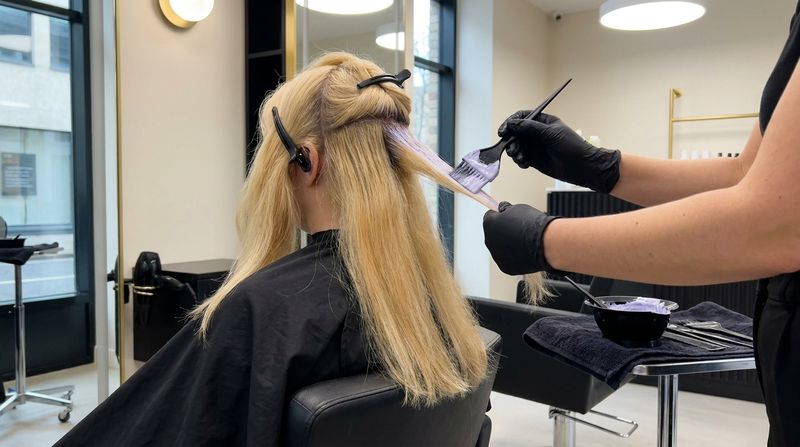
The page that counts is the one for the product you’re applying.
Why don’t the times match across these three brands?
Because each page measures something different. Dia Light’s US page gives one range for the whole line, Igora Vibrance’s “up to 20” is a cap with a different range for each service, and Shades EQ’s 20 minutes is a standard time with a longer one for gray hair.
Notice one thing: the number 20 shows up on all three pages, but it doesn’t play the same role on all of them. On Dia Light’s US page and on Igora Vibrance’s pages, 20 minutes is the ceiling. On Shades EQ’s pages, 20 minutes is the standard time, and gray hair can go up to 40. Where each range starts also changes: 2 minutes for Dia Light (US), 5 for an Igora Vibrance gloss, 10 for an Igora Vibrance global application. The “What it refers to” column matters more than the time column.
Before you set a time, answer four questions:
- Which line is in the bowl.
- How you are applying it (on dry hair, or on shampooed, towel-dried hair).
- Which service you are doing (global, regrowth, gloss).
- Which market the page you’re reading is from.
That’s the rule worth keeping: the time comes from combining line, application, service and market, and if you don’t know which of them a figure refers to, don’t set the timer by it.
The condition of the hair is a separate question. Redken’s US page for Shades EQ does turn it into minutes: up to 40 for gray hair and, for resistant hair, 15 minutes with a plastic cap under a pre-heated warm dryer, then 5 minutes to cool with the cap off. The same page says Shades EQ blends gray hairs, so the extra time is not a coverage promise. How to approach the formula on porous areas is in the hair gloss guide; on the clock, those areas are the ones you watch during processing.
What do the Dia Light pages say, and what do they leave out?
The L’Oréal Professionnel US page for Dia Light gives a development time of 2 to 20 minutes, and it also calls it a “Fast processing time: 2 - 20 minutes.” It doesn’t say which part of that range goes with which shade, service or hair type.
The UK page does tie the time to the application. On dry hair, it gives 20 min. For a toning application on shampooed, towel-dried hair, it gives 5-20 minutes depending on the desired outcome.
The mix is written differently in each market. The US page asks for a “1 to 1.5 mixing ratio”: one 2 oz. tube to 3 oz. of DIActivateur Developer, at 6-vol (1.8%), 9-vol (2.7%) or 15-vol (4.5%) depending on the intensity you want, with 6 / 9 vol recommended. The UK page mixes 1:1.5 and says to use exclusively the recommended 6 vol (1.8%) or 9 vol (2.7%) DIActivateur. For a refresher on what changes as you go up or down in volume, see the guide to developer volumes.
Neither page breaks the time down by shade. For that, check the directions that come with the product and, if the time isn’t there either, ask the brand’s technical support. A strand test shows how that hair responds within the range.
How many minutes does Igora Vibrance need, by service?
The Schwarzkopf Professional US page for Igora Vibrance says the development time is up to 20 minutes, and it breaks that down by service: 10-20 minutes for a global full head and for regrowth, and 5-20 minutes for a gloss service. The UK page says the same thing, word for word.
Two services, two ranges. The “up to 20” is the cap of both; what changes is where each one starts: a gloss starts at 5 minutes and a global application at 10.
The product page leaves out the mix. The Igora Vibrance technical manual (English edition, UK spelling) gives it: “an easy 1:1 mixing ratio for all shades”, with activators at 1.9% | 6 Vol. and 4% | 13 Vol.
How long do you leave Shades EQ: 20 minutes, or 40?
Redken’s US page and its UK page give the same instruction: “Process at room temperature for 20 minutes, up to 40 minutes for gray hair.” Both mix it 1:1 with Shades EQ Processing Solution.
So 20 minutes is the general time, and the 40 belongs to gray hair. The US page adds that Shades EQ is applied on dry hair and processed for 20 minutes, and that any variation in processing time, or applying it on wet hair, costs color longevity, color accuracy, conditioning and bonding benefits. The shades and starting formulas for the line are in the Shades EQ color chart, and the comparison with Igora Vibrance is in the Redken vs Schwarzkopf guide.
Do you need an allergy test before a toner?
Plan for it when you book, not when you mix: a toner is still a color product. Look in the directions that come with the product for whether an allergy alert test is needed and how far ahead of the service it has to be done. If they ask for one, leave the full lead time they give between the test and the color service.
For Igora Vibrance, the technical manual puts it in writing: “If, after carrying out the Professional Safety Evaluation an Allergy Alert Test is required this should be performed 48 hours before the colour service.”
The US and UK product pages for Dia Light and Shades EQ don’t give the timing of the test. With those two lines, look for the test and its timing in the directions that come with the product. The guide to the allergy patch test without losing the appointment shows how to fit it into the schedule.
How do you set the timer when you work with several brands?
Picture a Tuesday afternoon. The person in your chair has just had a lightening service and the blonde still leans yellow. On the shelf there is more than one gloss line, and the timer is still set to the minutes of the last service. Before the clock, one more check: Redken’s US page says Shades EQ is applied on dry hair and that wet application costs longevity, while the UK Dia Light page gives both: 20 minutes on dry hair, or 5-20 minutes as a toner on shampooed, towel-dried hair. The line in the bowl, and the service you are doing with it, decide whether you dry first.
Five habits so the product sets the clock:
- Read the product in the bowl before you touch the timer: line and shade.
- Look up its time and what it refers to: for Dia Light, check which market your tube is from: the UK page splits the time by dry or towel-dried hair, the US page gives 2 to 20 minutes with no split; for Igora Vibrance, check the service you are doing; for Shades EQ, check whether there is gray hair in the area.
- Read the directions that come with the product first: they rule. If they don’t break the time down for your case, the brand’s page fills in what they leave out, and the brand’s technical support covers what neither gives.
- Write the time down before you mix, along with the line and shade, where whoever rinses the product will see it.
- Watch the porous areas during processing: the range is set by the page (or by the directions that come with the product) and, within it, you decide by looking at the hair. If an area grabs more color than you want, note it and correct the formula for next time. The final result is judged with the product already rinsed out and in light that doesn’t mislead. Cutting it short by default has a cost: you’ll see it in mistake 1.
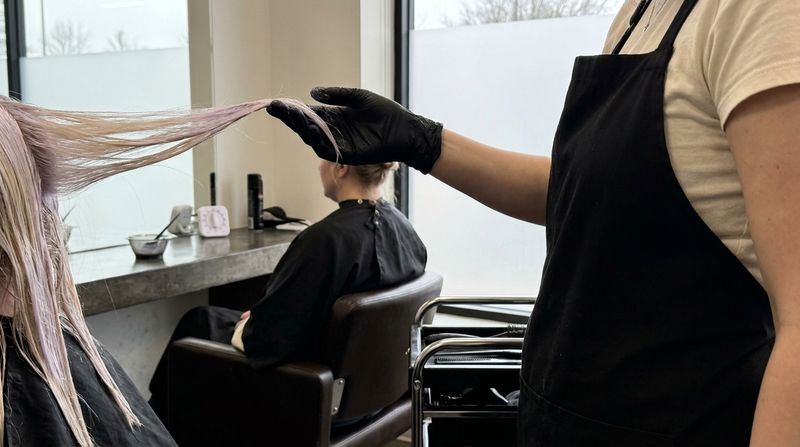
During processing you watch; the result is judged with the product already rinsed out.
Pro tip: in each client’s record, note next to the time which document it came from (the directions that came with the product, the US page or the UK page). If the result doesn’t last, it is one of the first things you’ll want to review, along with porosity and the starting base.
What mistakes get made with toner time?
1. Staying below the range because it “already looks right”
The mistake: taking the toner off before the minimum on its page because, halfway through and with the product on, the strand looks finished.
The result: with Shades EQ, the Redken US page, which gives 20 minutes as the general time, warns that any variation in processing time costs color longevity and accuracy.
The fix: with Dia Light and Igora Vibrance, you choose within the page’s range by looking at the hair, and you don’t go under the minimum. Shades EQ gives no shorter time at room temperature: Redken’s US page asks for 20 minutes and warns that any variation in processing time costs color longevity and accuracy (its 15-minute option is with a cap under a pre-heated dryer, for resistant hair). If an area grabs more color than you want, the correction goes into the next formula.
2. Reading Dia Light’s range without its condition
The mistake: taking the 2 to 20 minutes on the US page as one number, and setting the low end or the high end out of habit.
The result: a time picked out of habit from a range the US page doesn’t break down. If your tube was sold in the UK, its page does split it (20 min on dry hair, 5-20 minutes as a toner on shampooed, towel-dried hair); if it was sold in the US, look for the split in the directions that come with the product.
The fix: decide first how you are applying it, and choose within the range by looking at the hair.
3. Using Igora Vibrance’s gloss timing on a global application
The mistake: rinsing a global full head or regrowth at gloss times because it is the same product.
The result: a service processed below the 10 minutes its page gives for global and regrowth (the 5-minute start belongs to the gloss service).
The fix: keep both ranges at hand, 10-20 for global or regrowth and 5-20 for gloss.
4. Mixing markets
The mistake: applying one market’s instructions to a product bought in another.
The result: a developer or time the instructions for your product don’t give. Dia Light is the clear case: a formula copied from a US source can call for 15-vol (4.5%), and the UK page says to use exclusively 6 vol or 9 vol.
The fix: say which page each figure comes from, and follow the one for the market where your product was sold.
5. Skipping the allergy test because “it’s just a gloss”
The mistake: thinking a toner doesn’t need one.
The result: a color product applied without the test its directions call for.
The fix: check the product’s directions when you book and, if they ask for a test, schedule it with the lead time they give. For Igora Vibrance, the technical manual sets it at 48 hours before the color service when the Professional Safety Evaluation calls for it.
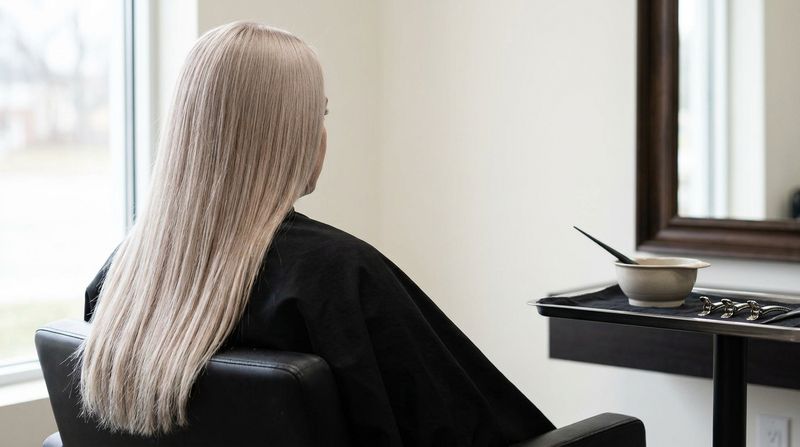
The clock is one of the pieces; the starting base and porosity are the others.
Frequently asked questions
How long do you leave Dia Light on?
The L’Oréal Professionnel US page gives a development time of 2 to 20 minutes for the line, with no breakdown by shade. The UK page ties the time to the application: 20 min on dry hair, and 5-20 minutes as a toner on shampooed, towel-dried hair, depending on the result you want.
How long do you leave Igora Vibrance on?
Schwarzkopf Professional’s US and UK pages say up to 20 minutes: 10-20 minutes for a global full head or regrowth, and 5-20 minutes for a gloss service.
How long do you leave Shades EQ on?
Redken’s US and UK pages say to process at room temperature for 20 minutes, up to 40 minutes for gray hair, mixed 1:1 with Shades EQ Processing Solution.
Can I use the same timer for every toner?
No. The three pages count time in different ways: one gives a range for the whole line, another splits it by service and the third gives one standard time plus a longer one for gray hair. The product in the bowl sets the timer.
Do I need an allergy test before a toner?
Check the directions that come with the product: look there for whether an allergy alert test is needed and how far ahead of the service. The Igora Vibrance technical manual (English edition) says that if, after the Professional Safety Evaluation, an Allergy Alert Test is required, it is done 48 hours before the color service.
In summary
- Each brand, its own clock: Dia Light, Igora Vibrance and Shades EQ don’t ask for the same minutes, and a single timer won’t do for all three.
- Read what the number refers to: the application, the service and the market of the page change what the time means. The same 20 is the ceiling for Dia Light (US) and Igora Vibrance, and the standard time for Shades EQ.
- The instructions in hand come first: the directions that come with the product rule; the brand’s page fills in what they leave out, and the brand’s technical support covers what neither gives.
- The test is booked, not improvised: if the product’s directions ask for an allergy alert test, it goes in the book ahead of the service, with the full lead time they give.
Calculate professional formulas with AI
Want to generate personalized toning formulas based on each client’s starting level and chemical history?
Does your timer know which brand is in the bowl today?
Related articles
Practice with our colorimetry tools
Calculators, neutralization wheel, AI consultation...
The Blendsor newsletter
Color techniques and trends for professionals. No spam.
You know the theory. What about today's case?
Send a photo to the Blendsor advisor and get an answer grounded in colour theory: toner, developer and timing, with the brands on your shelf.
Ask about your caseWritten by the Blendsor team
Professional hair colorimetry experts with experience in AI-assisted formulation. We combine color science, salon practice and technology to help colorists formulate with precision.