Which Developer to Use to Darken Hair, Brand by Brand
Going darker isn't decided by how many levels you drop: each brand's sheet names its own developer. Dia Color, Koleston Perfect and Igora Royal, with sources.
Blendsor
Blendsor Team
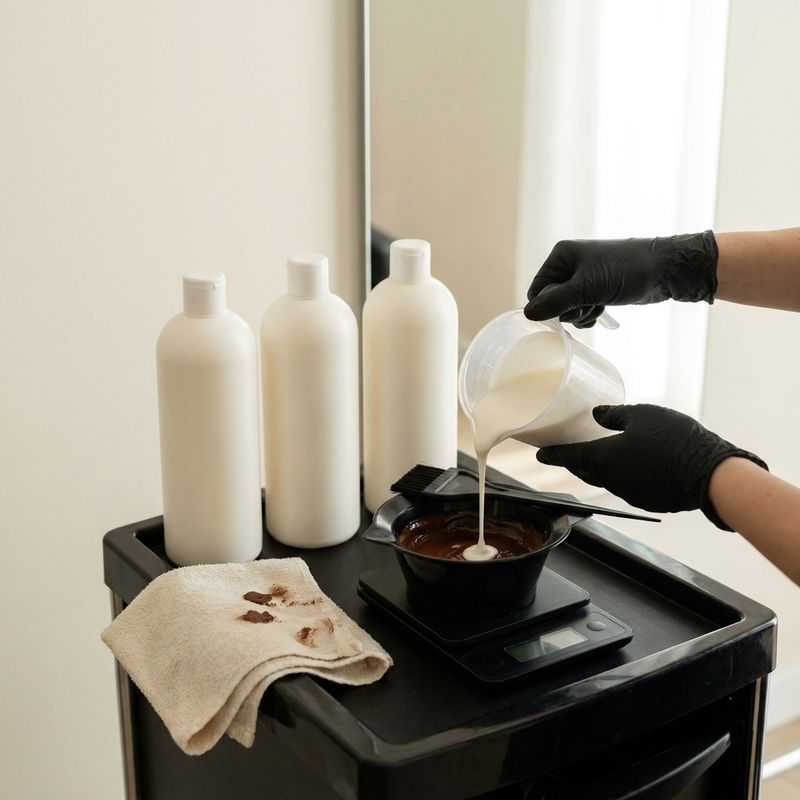
Someone sits down with a natural brown, not a single gray hair, and asks to go two shades darker. You have the tube in your hand and three developer bottles on the cart. Which one do you open?
If you work with more than one line, the answer that comes fastest is the one from the line you used last. And that’s the trap: the same number of volumes doesn’t mean the same thing on every brand’s sheet. Here is what the sheets of three widely used lines say about going darker, with the source for each, and how to choose when yours isn’t listed.
Which developer do you use to darken hair?
The one your line’s sheet gives for depositing color without lifting. Among the three sheets we look at here, no single volume repeats: the Spanish sheet for Dia Color recommends 6, 9 or 15 volumes depending on how much color you want to leave, Wella’s Koleston Perfect gives 4% (13 vol) or 6% (20 vol) for same depth or darker, and Igora Royal’s Spanish manual gives 3% (10 vol), which also covers 100% of gray.
| Line | Developer to go darker | What the sheet says |
|---|---|---|
| Dia Color (L’Oréal Professionnel, Spanish sheet) | Dia Activateur at 6, 9 or 15 vol, mixed 1:1.5 | Soft, medium or intense: the volume follows the color deposit |
| Koleston Perfect (Wella’s global usage guide) | Welloxon Perfect at 4% (13 vol) or 6% (20 vol), mixed 1:1 | Same depth or darker; 4% is for natural hair with no gray to cover |
| Igora Royal (Spanish technical manual) | Activator lotion at 3% (10 vol) | The “darken” column; the same column covers 100% of gray |
Look at what the table doesn’t do: it doesn’t link a volume to “drop this many levels”. Each brand organizes its guide differently, so the volume you used with one line doesn’t carry over to the next as is.
Dia Color: the volume follows the color deposit
According to the Spanish sheet for Dia Color, from L’Oréal Professionnel, this ammonia-free demi-permanent goes up to 4 shades darker and is mixed 1:1.5. For best results, the Spanish sheet recommends Dia Activateur at 6 vol for a soft color deposit, 9 vol for medium and 15 vol for intense.
Those 4 shades are the most the brand advertises for the product. The Spanish sheet lists them separately from the volumes: it doesn’t say that 15 vol gets you 4 shades darker, or that 6 gets you less. What changes from one bottle to the next is how much color you want to leave. And they’re recommendations: the sheet itself allows any Dia Activateur with Dia Color.
Go back to the natural brown who wants two shades darker. With Dia Color, the question before you open the bottle isn’t “how many levels do I drop?” but “how intense a deposit do I want?”. The sheet gives no processing time, so the strand test is what tells you how that hair responds to the volume you pick.
Koleston Perfect: 4% with no gray, 6% when there is gray
Wella’s usage guide for Koleston Perfect gives two rows for staying at the same depth or going darker. The 4% (13 vol) is for deeper results on natural hair when no gray coverage is required. The 6% (20 vol) also appears for same depth or darker, but it is also the row the guide dedicates to gray coverage: in the Welloxon Perfect box it is the row with gray coverage, while the 4% is for natural hair with no gray to cover and the 9% and 12% only give levels of lift.
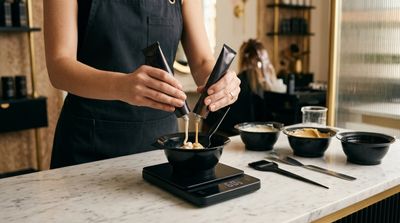
The mix is 1:1, 60 g of Koleston Perfect with 60 g of Welloxon Perfect. Weighing it, not eyeballing it, is what lets you repeat today’s formula next time.
With the same person from the example, if they had gray, the 4% would stop being your row and the 6% would take its place. How that case is formulated is covered in the article on which developer to use for a root touch-up with gray, so we won’t repeat it here.
A note on scope: this is Wella’s global guide. Each brand, and sometimes each country, sets its own limit: check your manual.
Igora Royal: 3% darkens and also covers 100% of gray
In the activator lotion usage guide of the Spanish Igora Royal technical manual, the 3% (10 vol) sits in the “darken” column. That same column says it also covers 100% of gray, although the 6% (20 vol) also appears for gray coverage.
The US wall chart for Igora says something similar: in its oil activator guide, the 3% (10 vol) is for coloring darker and covering 100% of gray, and the 6% (20 vol) for tone-on-tone, gray coverage and lifting 1-2 levels.
If you come from Koleston, watch the 6% (20 vol). In Igora Royal’s Spanish manual, the “darken” volume is the lowest of the four in its guide, and the 6% goes to tone-on-tone, gray coverage and 1-2 levels of lift. At Wella, that same 6% is also listed for same depth or darker.
Same number, different sheet
The 6% is a good example, because it appears in two of the three sheets and doesn’t say the same thing in each (and it isn’t the “6” on Dia Color’s Spanish sheet, which stands for 6 vol):
| The 6% (20 vol) in… | What the sheet assigns it |
|---|---|
| Koleston Perfect (Wella’s global guide) | 1 level of lift, gray coverage, and same depth or darker |
| Igora Royal (Spanish manual) | Tone-on-tone, 1-2 levels of lift and gray coverage |
Same concentration, and in one line it sits next to “darker” while in the other it sits next to “tone-on-tone”. The rule worth keeping is short: to go darker, find the row your sheet dedicates to it and use the developer it names.
If your line isn’t here: how to read its sheet
- Look for the darkening row, not the lifting one. It may be called “same depth or darker”, “darken” or “color deposit”. If there’s also a “tone-on-tone” row, check which of the two names darkening: in Igora Royal they’re separate columns.
- See what the sheet ties the volume to. In Dia Color, the deposit. In Koleston Perfect, whether there’s gray to cover. In Igora Royal, the service: darkening, tone-on-tone or lifting.
- If there’s gray, look again. Within the same depth, the developer can change, as it does in Koleston Perfect from 4% to 6%.
- Respect the sheet’s ratio. Changing it isn’t a shortcut to more gray coverage: our guide to mixing ratios explains why.
And if what you’re darkening is lightened blonde, the developer may not be the underlying decision: if the base has been left too light, you first have to put back the pigment the lightening took out. We cover that in pre-pigmentation when going darker, from blonde to brown. For the general volume table, the developer volumes guide is the place.
Before you mix: the allergy test, brand by brand
It isn’t a formality you skip with someone you trust. What each sheet says:
- Dia Color: the Spanish sheet requires the allergy test 48 hours before each use.
- Koleston Perfect: the leaflet asks you to always do the allergy test 48 hours before any color service. If redness, burning or itching appears, the color isn’t applied and the person sees a doctor before coloring again; and if they have ever had an allergic reaction to a dye, they aren’t colored.
- Igora Royal: the Spanish manual gives no window. Blendsor’s minimum is an allergy test, not on the same day as the color appointment.
How to fit it into the schedule: the 48-hour allergy test. And the strand test shows you how that hair responds to the mix, exactly what Dia Color’s sheet doesn’t give you. If the hair has a chemical history or is sensitized, cross-check with an elasticity test.
Frequently asked questions
Which developer volume darkens the most?
Among these three sheets there is no common scale, so compare within your line, not across lines. For Dia Color, the Spanish sheet recommends 6, 9 or 15 volumes depending on the color deposit (soft, medium, intense). In Igora Royal’s Spanish manual, the one listed with “darken” is the 3% (10 vol), which also covers 100% of gray. In Koleston Perfect they are the 4% (13 vol) and the 6% (20 vol), while its 9% and 12% rows only give levels of lift.
Can I use a volume other than 6, 9 or 15 with Dia Color?
The Spanish sheet says you can use any Dia Activateur with Dia Color, and that those three are its recommendation for best results. If you step outside them, do a strand test first.
What if there’s gray?
The row changes. In Koleston Perfect, the 4% is for natural hair with no gray to cover and the 6% (20 vol) is the coverage row. In Igora Royal’s Spanish manual, the 3% (10 vol) also covers 100% of gray, and the 6% (20 vol) is also listed for gray coverage. Dia Color covers up to 70% of white hair, according to the Spanish sheet. The full root touch-up case is in this article.
Does a thicker mix cover gray better?
Wella advises against it in writing in its UK gray coverage tips sheet for Koleston Perfect: using a different mixing ratio, with more color cream, can give an unpredictable result and doesn’t meet its safety guidelines. How coverage is reinforced is detailed in the ratios guide.
In short
- To go darker, your line’s sheet decides: the developer comes from the row it gives for darkening.
- On its Spanish sheet, Dia Color ties the volume to the deposit (6, 9 or 15 volumes). Koleston Perfect gives 4% with no gray and 6% when there is gray. Igora Royal gives 3%, which darkens and also covers 100% of gray.
- The same 6% doesn’t say the same thing in Koleston Perfect and Igora Royal: always compare within your own line.
- Allergy test before mixing: 48 hours on Dia Color’s Spanish sheet and in Koleston Perfect’s leaflet; for Igora Royal, which gives no window, Blendsor’s minimum: not on the same day as the color appointment.
Calculate the formula with each line’s developer
Want the developer for the line you use, the starting level and each person’s history to arrive already calculated in the day’s formula?
Which line gives you the most trouble when it’s time to choose the developer for going darker?
Manufacturer sources
Manufacturer documents consulted for this article. A copy of each one is kept, and the passages noted from it are checked against that copy.
Note each one's country: the same line's instructions can differ from one market to another, so follow the directions for the product you use.
Which developer volume do you use to darken hair?
In the app, we ask you a question like this one, but about your own client.
Up for this week’s case? →Related articles
Practice with our colorimetry tools
Calculators, neutralization wheel, AI consultation...
The Blendsor newsletter
Color techniques and trends for professionals. No spam.
You know the theory. What about today's case?
Send a photo to the Blendsor advisor and get an answer grounded in colour theory: toner, developer and timing, with the brands on your shelf.
Ask about your caseWritten by the Blendsor team
Professional hair colorimetry experts with experience in AI-assisted formulation. We combine color science, salon practice and technology to help colorists formulate with precision.