Long-Lasting Red Formulas: Anti-Fade
Long-lasting red hair: why color fades, when to fill, which developer each line calls for and how to refresh between appointments, with Koleston Perfect and Igora Royal.
Blendsor
Blendsor Team
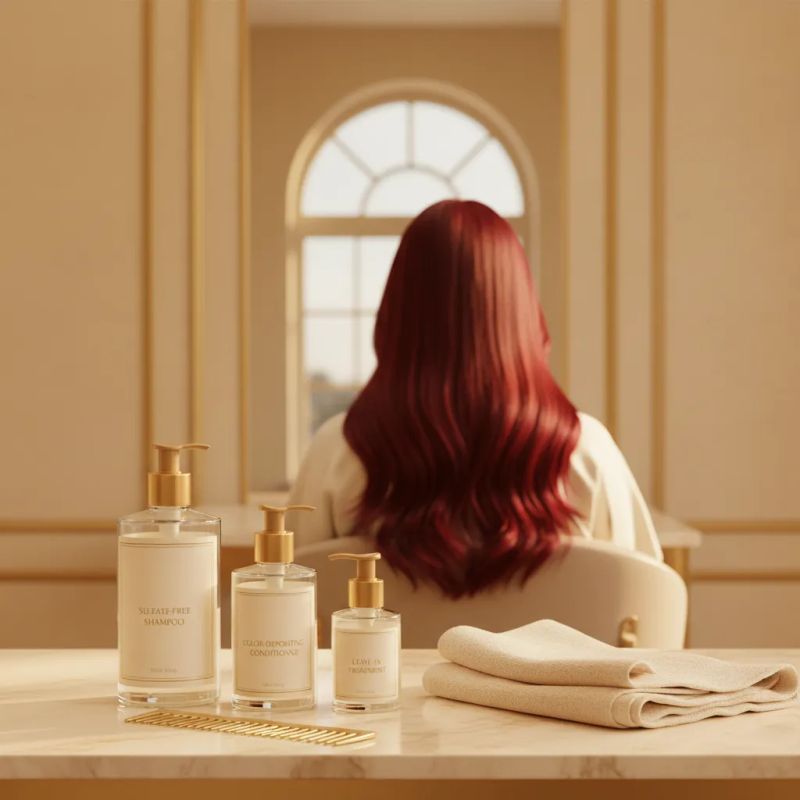
How many times has someone left the salon with a vibrant red, only to tell you a few weeks later that “it’s not red anymore”?
Reds are among the most beautiful colors and among the most frustrating. Color leaves mostly through washing: a study published in the Journal of Cosmetic Science on oxidative color fading during shampoo washing found that the color is lost primarily because the dye dissolves in water, and that the shampoo’s surfactant, the pH and the hair type all play a part. On a red, that loss shows sooner than on a natural shade.
The good news is that much of the longevity is decided in the chair: the diagnosis, the line and its developer, and the refresh between appointments. Let’s go through it with the manufacturers’ instructions in hand.
Quick summary: red fades because the dye dissolves in the wash water. What makes it last is a diagnosis that decides whether to fill first, your line’s formula with the developer its instructions call for (not a stronger one “to be safe”), and a demi-permanent refresh between appointments.
Why Do Reds Fade So Fast?
Because the dye dissolves in the water at every wash, and on a red that loss shows right away: a red that loses intensity reads dull, while a natural shade with the same loss still looks intact. The Journal of Cosmetic Science study measured it by varying the shampoo, the pH and the hair type.
Porosity speeds up the loss
Porous lengths take color fast and let it go fast. A red on damaged lengths goes in strong and fades before the regrowth does. That’s why the porosity check comes before the formula; see hair porosity and coloring.
The base’s underlying pigment
Lightening exposes the underlying pigment: red, orange or yellow, depending on how far the hair has been lifted (Wella describes it in its Koleston Perfect booklet when explaining how to neutralize it with the complementary color). On a medium base that background is orange; on a heavily lightened base there’s hardly any red or orange background left, and the red has nothing to hold on to.
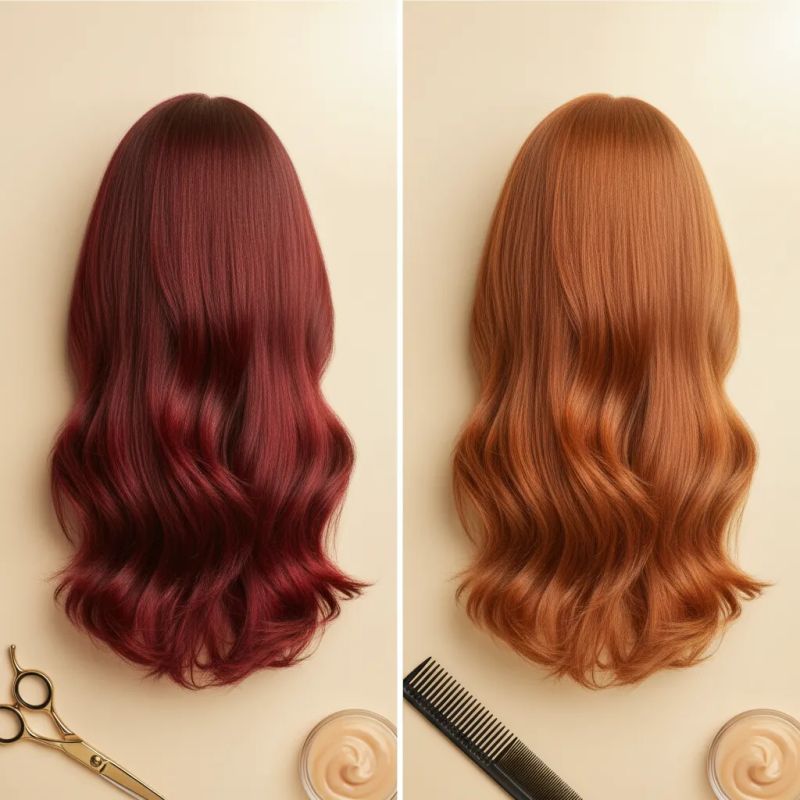
What Is the Three-Step Anti-Fade Strategy?
Diagnose and fill when needed, formulate with your line and the developer its instructions call for, and refresh with a demi-permanent between appointments. None of the three steps involves raising the developer.
Step 1: diagnosis and filling
Before formulating, look at where you’re starting. If the target is much darker than the current hair, especially on lightened or highlighted lengths, the red needs a base. Wella’s US professional store, in its Color Touch filling guide, recommends filling when the target is more than two levels darker than the starting level. In that same Wella US guide, the fill is mixed 1:2 with Color Touch Emulsion 1.9% and, in its step-by-step, develops up to 20 minutes. How to choose the filler shade is covered in pre-pigmentation for going darker.
Two tests come before all of that. Wella recommends a skin allergy test 48 hours before coloring in its global Koleston Perfect booklet. And if the hair has previous color, henna or high porosity, test the red first on a hidden strand (strand test). With henna, it may also be a compound henna: with metallic salts, developer can damage the hair. If the person doesn’t know what they used, treat it as compound until the strand test with the mix says otherwise. If the lengths are bleached, check the elasticity first: a wet strand that stretches and doesn’t spring back isn’t ready for another chemical process, and there the red starts with a treatment, not a filler.
Step 2: your line’s formula, with its developer
Depositing a red doesn’t need more developer than the instructions call for. In the global Koleston Perfect booklet, Welloxon Perfect 20 vol (6%) is the one for darker, tone on tone or 1 tone lighter; 30 vol, for 2 tones lighter; and 40 vol, for 3. On the US Igora Royal chart, 3% (10 vol) is for going darker, 6% (20 vol) for tone on tone or lifting 1-2 levels, and 9% (30 vol) for lifting 2-3. Raising the developer “to be safe” doesn’t give you more red: it gives you more lift, which is a different goal. The full breakdown is in developer volumes.
Step 3: refresh between appointments
An oxidative red can be revived between appointments with a demi-permanent from the same brand, without recoloring everything: Color Touch after Koleston Perfect, Igora Vibrance after Igora Royal, Shades EQ after a Redken color. Check the shade by its name on the demi-permanent’s chart, because not every line from the same brand carries the same shades. Wella’s US professional store recommends Color Touch Emulsion 1.9% for color deposit and glazing. For Shades EQ, Redken US gives up to 28 shampoos, and notes that cutting the time short or applying it to wet hair shortens that. How to build that gloss is in hair gloss.
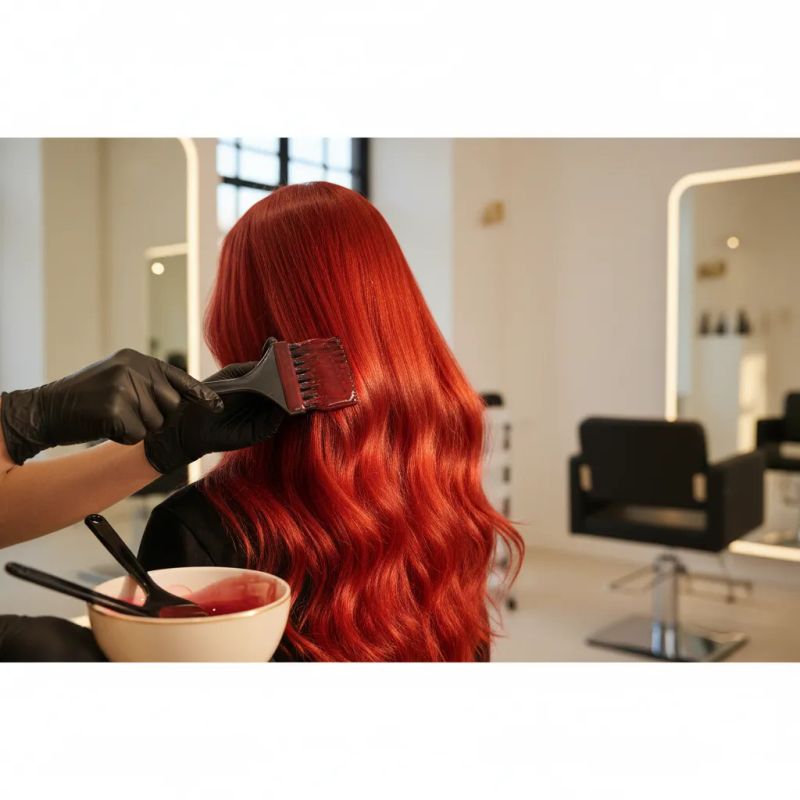
What Are the Professional Formulas by Type of Red?
Each brand numbers its tones its own way, so you build the formula with your line’s chart. In Wella’s Koleston Perfect, reds come from the Vibrant Reds family: the global booklet defines /4 as Red (warm), /5 as Mahogany (red/violet), /6 as Violet and /3 as Gold. In Schwarzkopf’s Igora Royal, the US chart names -8 Red, -7 Copper, -9 Violet and -5 Gold.
| Red you want | Tones to combine in Koleston Perfect (guide) | Tones to combine in Igora Royal (guide) |
|---|---|---|
| Cherry | /4 (red) with /5 (mahogany) | -8 (red) with a little -9 (violet) |
| Burgundy | /5 (mahogany) and /6 (violet), on a dark base | -8 (red) with -9 (violet), on a dark base |
| Copper | /4, with /3 (gold) for more gold | -7 (copper), with -5 (gold) for more gold |
| Strawberry blonde | /3 (gold) with a little /4 | -5 (gold) with a little -7 |
Combine shades of the same level that exist on your chart: if a tone isn’t available at that level in your line, don’t make it up.
The developer ratio is your line’s: 1:1 in Koleston Perfect (global booklet) and 1:1 in Igora Royal (US chart). The timing too: Koleston Perfect gives 30-40 minutes without heat or 15-25 with heat for a full head at the same depth or darker, and Igora Royal, 30-45 minutes. The exact amount of each tone is decided by the strand test, not by a table. For the red variations and their look, see romantic red hair.
If you need to lift
When the red has to lift natural hair, the global Koleston Perfect booklet applies the mix to the lengths and ends first, leaving about 2 cm free at the scalp, and then the roots.
If there’s gray
Reds cover gray with their own rule. The global Koleston Perfect booklet asks you to add 1/3 of a Pure Naturals shade with 30-50% white hair and, for red shades on more than 50% white hair, 2 parts red shade to 1 part Pure Naturals. On the US Igora Royal chart, with more than 50% gray, you add Natural or Beige in a 2:1 ratio.
What Common Mistakes Ruin Red Longevity?
The five that come up most: raising the developer “to be safe”, not filling when the base is much lighter than the target, treating roots and lengths the same, skipping the tests beforehand, and ignoring porosity.
Mistake 1: raising the developer “to be safe”
More volume lifts more; it doesn’t deposit more red. If the red has to lift more than the highest developer in its instructions covers (in the global Koleston Perfect booklet, 40 vol for 3 tones), plan a lightening service first and the red afterwards.
Mistake 2: not filling on a very light base
Red on lightened lengths without a base goes in strong on day one and fades fast. That’s the case where the Wella US guide asks you to fill first.
Mistake 3: treating roots and lengths the same
For a regrowth application, the global Koleston Perfect booklet starts at the roots, with 30-40 minutes without heat for Vibrant Reds, and to level the color on lengths and ends it dampens the hair and emulsifies for 5-10 minutes. The lengths already carry color: they don’t need the full time.
Mistake 4: skipping the tests
The allergy test and the strand test come before any red, all the more if the person has henna or previous color.
Mistake 5: ignoring porosity
Porous lengths tend to let red pigment go sooner. There, filling and the refresh between appointments matter more than the formula.
What Is the At-Home Maintenance Protocol for Long-Lasting Reds?
Since color leaves with the wash water, what helps most at home is washing less, with a shampoo for color-treated hair and water that isn’t hot. Add a heat protectant before hot tools and sun protection in summer.
Give it in writing at the end of the service:
- Wash as little as possible, with a shampoo for color-treated hair
- Lukewarm or cool water rather than hot
- Heat protectant before the dryer, flat iron or curling iron
- Sun protection for long days outdoors
- A red-depositing conditioner between appointments, if they want it more vivid
What Salon Maintenance Services Do Reds Need?
Three: the demi-permanent refresh between appointments, the root touch-up with leveled lengths, and, when the red has faded a lot, redoing the full color with a fresh diagnosis.
Refresh between appointments
A demi-permanent from the same brand, with the shade chosen by its name on the chart, recharges the red on the lengths: Color Touch after Koleston Perfect, Igora Vibrance after Igora Royal, with the time on its own chart. After a Redken red, Shades EQ: Redken US gives 20 minutes at room temperature on dry hair.
Root touch-up
The roots with the original formula and its full time; the lengths, leveled with a short time. It’s the order from the global Koleston Perfect booklet you saw in mistake 3. When to do a touch-up and when a gloss is in root touch-up or gloss.
Redoing the color
When a refresh no longer holds the red, go back to step 1: diagnosis, filling if needed, and your line’s formula.
What Role Does Underlying Pigment Play in Long-Lasting Reds?
The red and orange background the base leaves behind goes with the red. On a dark, natural base it’s all there, and the red can go on directly. On a medium base, that background leans orange and can push the red toward copper. On a heavily lightened base there’s hardly any left, and that’s where filling comes in.
On dark bases
The background is reddish and works in your favor. If the base is natural, the red can go on directly with the developer its instructions call for.
On medium bases
The background is more orange. If the red comes out too coppery, the violet side of the formula (/5 or /6 in Koleston, -9 in Igora Royal) cools it down.
On light bases
There’s hardly any red or orange background left: bleaching removes it to lift the level. That’s why, on a heavily lightened base, especially if the red you want is more than two levels darker, red goes in strong on day one and loses strength wash after wash unless you fill first.
To correct tones that show up along the way, see neutralizing unwanted tones.
Frequently Asked Questions
Why does my red turn orange so quickly?
Because as the red goes, the base’s orange or yellow background shows. It happens more on lightened or porous lengths, and when the developer is higher than the instructions call for. The fix is to fill the light areas first, use your line’s developer and refresh with a demi-permanent between appointments.
Can I use reds on bleached hair without filling?
You can, but it won’t last: bleached hair lacks the red and orange background that goes with the red. If the target is more than two levels darker than the base, the Wella US guide asks you to fill first.
How long should the first wash wait?
The instructions we cite don’t give a time for the first wash, so we won’t give you a number. What does help, given how color is lost, is making the first washes with a shampoo for color-treated hair and water that isn’t hot.
Do dark reds last longer than light ones?
They tend to hold better, because a dark, natural base keeps the red and orange background that goes with the red. A light red on a lightened base has less underneath it, and the loss shows sooner.
What do I do if the red faded too quickly?
Review the diagnosis: porosity, a base too light with no filling, or a developer higher than needed. Redo the service with filling if needed and the developer from the instructions, and book a demi-permanent refresh between appointments.
Recommended Products for Long-Lasting Reds
The lines that appear in this article, so you can find the shade on your chart:
- Wella Koleston Perfect (Vibrant Reds): Koleston Perfect’s red family, 1:1 with Welloxon Perfect.
- Schwarzkopf Igora Royal: its reds carry the -8 tone and its coppers the -7; 1:1 with the Oil Developer.
- Wella Color Touch: Wella’s demi-permanent for filling and refreshing.
- Redken Shades EQ: Redken’s demi-permanent, for refreshing a red done with Redken.
This article contains affiliate links. If you buy through them, we earn a small commission at no extra cost to you.
In Summary
- Red leaves with washing: the dye dissolves in water, and on a red it shows sooner
- Diagnosis first: porosity and base; if the target is more than two levels darker, fill
- The developer from the instructions: more volume lifts more, it doesn’t deposit more red
- Your line’s chart for the formula: each brand numbers its tones its own way
- Refresh between appointments: a demi-permanent from the same brand, with the shade chosen by name, brings the intensity back
- Home care: fewer washes, color-safe shampoo and water that isn’t hot
Calculate Red Formulas with AI
Want red formulas based on the starting level, the porosity and the brand you use in your salon?
Why do red shades fade faster than other tones?
In the app, we ask you a question like this one, but about your own client.
Up for this week’s case? → More on brunettes and coppers →Related articles
Practice with our colorimetry tools
Calculators, neutralization wheel, AI consultation...
The Blendsor newsletter
Color techniques and trends for professionals. No spam.
A client in the chair right now?
The Blendsor advisor gives you the precise formula for this technique with your salon's brands — and saves it to your client's card.
Ask about your caseWritten by the Blendsor team
Professional hair colorimetry experts with experience in AI-assisted formulation. We combine color science, salon practice and technology to help colorists formulate with precision.