Igora Royal vs Koleston Perfect: The Developer Difference
Igora Royal and Koleston Perfect do not write the same lift per developer volume. Both tables side by side, and what to check when you switch lines.
Blendsor
Blendsor Team
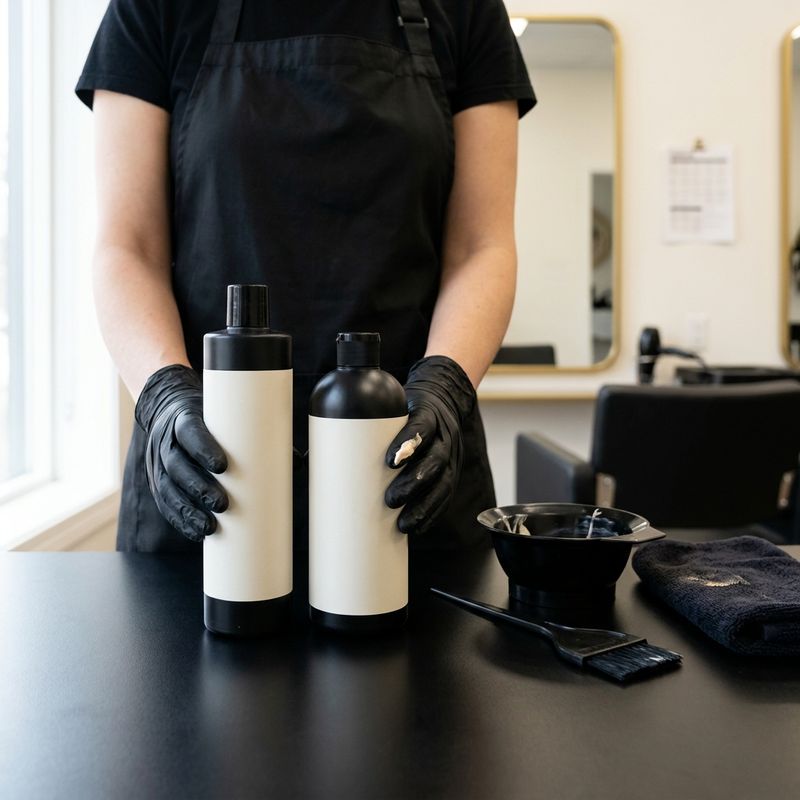
You have formulated with Igora Royal for years and the new salon runs on Koleston Perfect. You mix with the 20 vol you are used to, with the math you are used to in your head: one or two levels of lift. Then you open Wella’s Koleston Perfect booklet and, next to that volume, you read “1 tone lighter”.
The volume is called the same in both lines. What each document promises with it is not. Here are the two side by side, Igora Royal’s US wall chart and Wella’s Koleston Perfect usage booklet, and what to check every time you switch lines.
Quick summary: Igora Royal (Schwarzkopf Professional) and Koleston Perfect (Wella Professionals) each publish their own lift table, with their own developer. At 20 vol, Igora Royal’s US chart gives lifting 1-2 levels and Wella’s booklet gives “Darker/tone on tone/1 tone lighter” for Koleston Perfect. At 30 vol, Igora Royal gives 2-3 levels and Koleston Perfect, on a 1:1 mix, 2 tones. Volume alone does not tell you how much you will lift: read the chart of the line you are mixing, with its developer and its ratio.
What is the difference between Igora Royal and Koleston Perfect?
Igora Royal is a color line from Schwarzkopf Professional and Koleston Perfect is one from Wella Professionals. Each publishes its own tone code, its own developer and its own lift table, and that table is what you notice most when you switch: Igora Royal’s US wall chart gives it with its Oil Developer; Wella’s Koleston Perfect usage booklet, with Welloxon Perfect.
This is what each document says, row by row:
| Igora Royal (US wall chart) | Koleston Perfect (Wella usage booklet) | |
|---|---|---|
| Developer in its table | Igora Royal Oil Developer | Welloxon Perfect |
| 20 vol (6 %) | Tone-on-tone, coverage on white hair, lifting 1-2 levels | Darker/tone on tone/1 tone lighter (1:1 mix) |
| 30 vol (9 %) | Lifting 2-3 levels | For 2 tones lighter (1:1 mix) |
| 40 vol | One line for Fashion Lights, one for the Ultra Blonde (10-) series and one for the Special Blonde (12-) series | For 3 tones lighter (1:1 mix) |
| Highest-lift blondes | Special Blonde (12-) series, with its own line in the chart | Special Blonde (1:2 mix): 30 vol for 3 tones lighter and 40 vol for 4-5 tones lighter |
The full volume table for Igora Royal is in hair color developer: choosing volumes. Here you only get the rows that change when you move from one line to the other.
How much does 20 vol lift in Igora Royal and in Koleston Perfect?
According to their documents, 20 vol (6 %) is for tone-on-tone, coverage on white hair and lifting 1-2 levels in Igora Royal’s US chart, with its Oil Developer. In Koleston Perfect, with Welloxon Perfect, Wella’s booklet assigns it to “Darker/tone on tone/1 tone lighter”. The same number on the bottle; on paper, both list it for tone on tone, but they don’t give it the same lift.
Read the words as printed: Igora’s chart says levels, Wella’s booklet says tones lighter, and each is quoted here the way its own document writes it.
That is the row that throws people when they switch lines. In Igora Royal, 20 vol is the first volume in the chart that lifts, and for going darker the chart uses 10 vol (3 %). In Koleston Perfect’s booklet, 20 vol shares a row with “darker” and “tone on tone”, gives 1 tone lighter, and the 2 tones lighter show up one step higher: at 30 vol on the 1:1 mix.
Put another way, if your usual math was “20 vol, one or two levels”, you cannot copy it as is into Koleston Perfect. If your goal is 1 tone, that same booklet covers it at 20 vol. If it is 2, 30 vol on that mix is the row that holds it, and the trade’s rule still stands: the lowest volume that reaches the goal, checked on a strand.
What about 30 vol and 40 vol?
At 30 vol (9 %), Igora Royal’s chart gives lifting 2-3 levels. Wella’s booklet gives, on the 1:1 mix, “For 2 tones lighter” at 30 vol and “For 3 tones lighter” at 40 vol. Igora Royal writes ranges (1-2, 2-3); Koleston Perfect, on that mix, writes closed numbers (1, 2, 3). That 1:1 mix is the one for Pure Naturals, Rich Naturals, Vibrant Reds and Deep Browns.
In the 40 vol column, Igora Royal’s chart stops talking about the line in general: it gives one entry for Fashion Lights, one for the Ultra Blonde (10-) series and another for the Special Blonde (12-) series.
And Koleston Perfect’s booklet has two columns. On the 1:2 mix for Special Blonde, 30 vol is “For 3 tones lighter” and 40 vol is “For 4-5 tones lighter”.
Why can’t you carry one line’s table over to the other?
Because each table describes a whole combination: that line’s color, that house’s developer and that block’s ratio. Volume only says how much peroxide the developer carries; how many tones it gives is written by each house for its own line.
Three things change at once:
- The developer. Igora Royal’s table is written for its Oil Developer and Koleston Perfect’s for Welloxon Perfect. If you cross a color with the other house’s developer, neither table describes your mix.
- The ratio. In Wella’s booklet, the 1:1 and the 1:2 mixes each have their own rows, as you saw above. In Igora Royal, the Special Blonde series has its own entry and its own mix: it is in Igora Royal lighteners: mixing ratio.
- The document. Every figure belongs to a market and an edition. The percentage of gray at which Igora Royal asks you to add a natural shade, for example, is not the same in its US chart as in its Spanish technical manual. That is why the figures here come from the US chart and from Wella’s global booklet, and each sentence names its document.

What should you check when you switch from Igora Royal to Koleston Perfect, or back?
Six checks, in this order, before you trust a figure from the new line:
- Start with the diagnosis. The hair’s history (earlier color, perms, earlier lightening) and the percentage of gray decide which product you reach for. The chart comes second.
- Open the line’s document and check it is the one for your market. Look at the market and the edition before reading a figure.
- Find the name of the developer in its table. Igora Royal Oil Developer in Igora Royal; Welloxon Perfect in Koleston Perfect.
- Find the row for your goal and the mix block. Darker, tone on tone or lift; and, in Koleston Perfect, 1:1 or 1:2 mix.
- Check whether the series you will use has its own table. the Special Blonde (12-) series in Igora Royal; the Special Blonde block (1:2 mix) in Koleston Perfect.
- Do a strand test with your real mix. The table is the house’s promise; the strand is what that hair does.
Before you color or lighten:
- Allergy test: Wella’s global Koleston Perfect usage booklet recommends a skin allergy test 48 hours before coloring. With Igora Royal, follow what its own sheet asks. How to fit it into your book: 48-hour allergy patch test.
- Strand test: it shows how that hair responds to the mix and the volume you picked, something no table can tell you. Step by step: strand test.
- Elasticity: if the hair is sensitized, cross-check with an elasticity test.
Pro tip: when you write a formula on the client card, note the volume next to its developer and its ratio. “20 vol” on its own is half a formula.
Other differences you notice when you switch lines
The developer comes first, but it is not the only thing that changes:
- Tone digits. The same digit does not mean the same thing: on Igora Royal’s US chart, -8 is “Red”, and in Wella’s Koleston Perfect booklet, /8 is “Pearl”. Both manuals at once in what shade 8 means: Wella is not Igora.
- Ratios by line. Each one has its exceptions; the full table is in what 1:1, 1:1.5 and 1:2 mean in hair dye.
- What happens after you pick the volume. Time, heat and porosity also move the result: why 30 volume delivers fewer levels.
- Changing brands altogether. Inventory, tests and transition in switching professional hair color brands.
Frequently asked questions
Does 20 vol lift the same in Igora Royal and in Koleston Perfect?
Their documents do not write it the same way. Igora Royal’s US chart gives lifting 1-2 levels for 20 vol with its Oil Developer. Wella’s booklet assigns 20 vol with Welloxon Perfect to “Darker/tone on tone/1 tone lighter”. What that mix does on your client is told by the strand test, not by the number on the bottle.
Which Koleston Perfect volume is equivalent to Igora Royal’s 20 vol?
There is no one-to-one equivalence between the two documents: each one speaks about its own line. If your goal is 2 tones of lift, Wella’s booklet puts it at 30 vol on the 1:1 mix; if it is 1 tone, at 20 vol. Start from that row and confirm it on a strand.
Can I mix one line’s color with the other line’s developer?
The lift tables are written for each color with its own developer: Igora Royal’s with its Oil Developer, Koleston Perfect’s with Welloxon Perfect. The most predictable choice is the developer of the line you are mixing. If you cross the two, neither of these tables tells you how many tones to expect, and you will only find out by testing on a strand.
Where do I find each line’s table?
On Igora Royal’s US wall chart, the Oil Developer usage guide is on page 1. In Wella’s Koleston Perfect usage booklet, the mixing table is on page 27. Check that the document is the one for your market.
Do I need the allergy test with both lines?
Wella’s global Koleston Perfect booklet recommends a skin allergy test 48 hours before coloring. With Igora Royal, follow what its own sheet asks. The strand test does not replace it: it answers a different question, how the hair reacts to that mix.
In summary
- Each line writes its lift table with its own developer and its own ratio. Volume alone does not tell you how many tones you lift.
- At 20 vol: for lift, Igora Royal gives 1-2 levels and Koleston Perfect, 1 tone lighter (US chart and global booklet). Both also list it for tone on tone.
- At 30 vol: 2-3 levels in Igora Royal; in Koleston Perfect, 2 on the 1:1 mix and 3 on the 1:2 Special Blonde mix.
- Before switching lines: the document for your market, the name of the developer, the mix block and a test strand.
Formulate with your brand’s data
In the Blendsor app you pick your brand and your line, and the formula is written for that line. If what you are switching are tone codes, the hair color converter has the Igora and Wella charts. Formulate with Blendsor.
The last time you switched lines, what was the first thing you checked on a strand?
Do Igora Royal's US wall chart and Wella's Koleston Perfect booklet still give the same lift rows per developer volume?
In the app, we ask you a question like this one, but about your own client.
Up for this week’s case? →Related articles



Practice with our colorimetry tools
Calculators, neutralization wheel, AI consultation...
The Blendsor newsletter
Color techniques and trends for professionals. No spam.
You know the theory. What about today's case?
Send a photo to the Blendsor advisor and get an answer grounded in colour theory: toner, developer and timing, with the brands on your shelf.
Ask about your caseWritten by the Blendsor team
Professional hair colorimetry experts with experience in AI-assisted formulation. We combine color science, salon practice and technology to help colorists formulate with precision.