Copper Hair Formulas 2026: From Dark Copper to Ginger
Detailed copper hair formulas by brand (Wella, Schwarzkopf, L'Oréal) and starting level. Application techniques and corrections for professionals.
Blendsor
Blendsor Team
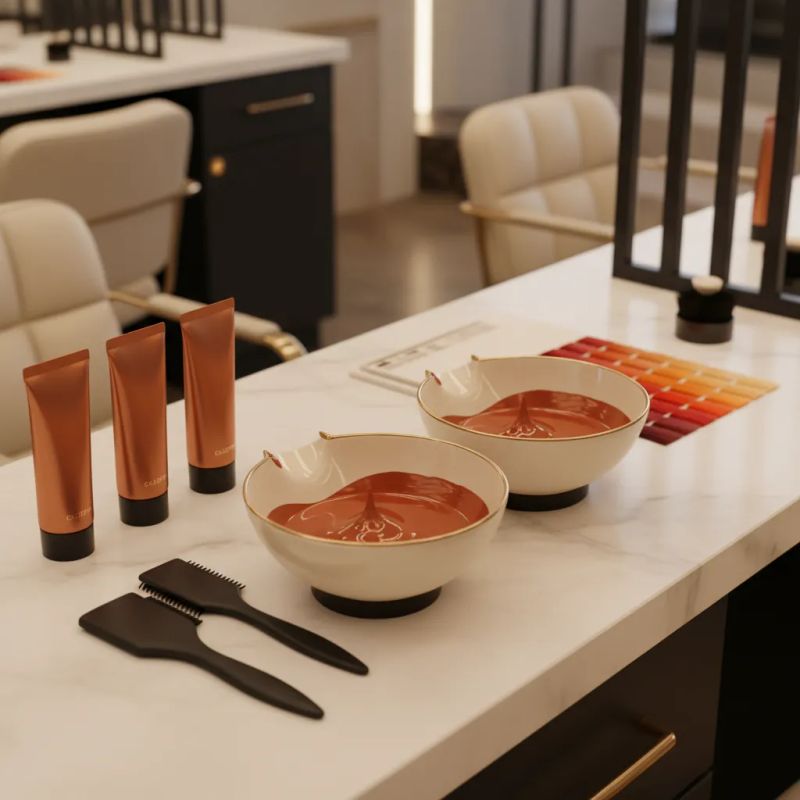
Your client shows you a copper hair photo from Instagram and you think: “great, but which brand and what reflect code gets me exactly that”?
If you work with copper hair color formulas regularly, you know the difference between editorial copper and carrot orange comes down to the formula. Not the intention, not the technique: the numbers you mix. We already covered what the Ginger Glow trend is and its variants, but now it is time for what truly matters in the salon: concrete formulas based on the brand you use and the starting level.
Quick summary: A copper formula is built around the copper reflect, with a gold that brings light and, when needed, a natural that pulls the saturation down. Each brand writes it its own way: /4 in Koleston Perfect (Red in Wella’s international legend), -7 in IGORA ROYAL and .4 in Majirel. Left on its own, straight copper tends to go flat and orange. On natural hair, the color itself lifts as far as its data sheet allows (Koleston Perfect: up to 3 levels with 12%), and those figures don’t account for lengths that already carry color. Developer and timing come from your line’s data sheet, not from a blanket 20 vol.
How Do Copper Pigments Work in Formulation?
A salon copper rarely comes out of a single tube. Copper sets the direction, a gold at the same level brings light and, when the photo calls for a more natural read, a natural takes some saturation out. What changes from brand to brand is how each piece is written. In Wella’s international Koleston Perfect legend the /4 is Red (warm). On Schwarzkopf’s IGORA chart for the US, -7 is Copper. On the Majirel color chart for the US, copper is .4, labeled C. So every code in this guide comes with the chart it belongs to:
| Reflect | Koleston Perfect (Wella, international chart) | IGORA ROYAL (Schwarzkopf, UK shop) | Majirel (L’Oréal, US chart) | When to use it |
|---|---|---|---|---|
| Copper | 7/4 | 5-7 Light Brown Copper (no 7-7 turns up in the UK listing; at level 7 the copper extra is 7-77) | 7.4 (C) | Sets the direction; needs a second reflect beside it |
| Copper gold | 7/43 | No copper-gold (-75) turns up in the UK listing | 7.43 (CG) | Luminous copper, the base of editorial ginger |
| Gold copper | 7/34 | 7-57 Medium Blonde Gold Copper | 8.34 or 6.34 (GC); the chart has no 7.34 | Soft copper, a first step into copper |
| Intense copper | 77/44 | 7-77 Medium Blonde Copper Extra | 7.40 (CCC) | Maximum impact |
| Natural | A Pure Naturals shade at the same level | 7-0 Medium Blonde Natural | 7 (N) | Tones down saturation without adding a reflect |
Wella’s international chart lists codes without shade names. IGORA ROYAL codes and names come from Schwarzkopf’s UK shop; the reflect legend, from its US chart.
Read across the table and the working rule fits in one line: straight copper needs company. A copper-gold or a gold at the same level gives it dimension, and the natural acts as a brake when the photo asks for a more muted copper. How each reflect behaves over the underlying pigment at each level decides whether you get the result you planned or a surprise. If you want to see where a mix is heading before you weigh it, the hair color mixing calculator blends two shades you pick, in the ratio you set, and predicts the resulting level and reflect. It doesn’t look at the starting hair and it doesn’t build the formula.
If the photo you are shown does not make it clear which copper it is, decide first between copper, peach or ginger: the reflect that leads changes the whole recipe.
What Are the Copper Formulas by Professional Brand?
In Wella’s Koleston Perfect, copper comes from the Vibrant Reds family: an intense level 7 copper is built on 77/44 and 7/43. In Schwarzkopf’s IGORA ROYAL it comes from the -7 and -77 coppers and the -57 gold copper. In L’Oréal’s Majirel, from .4, .43 and .40. Each brand has its own color-to-developer ratio (1:1 for Koleston Perfect and IGORA ROYAL, 1:1.5 for Majirel), and the volume depends on how much lift you need, not on the shade being copper.
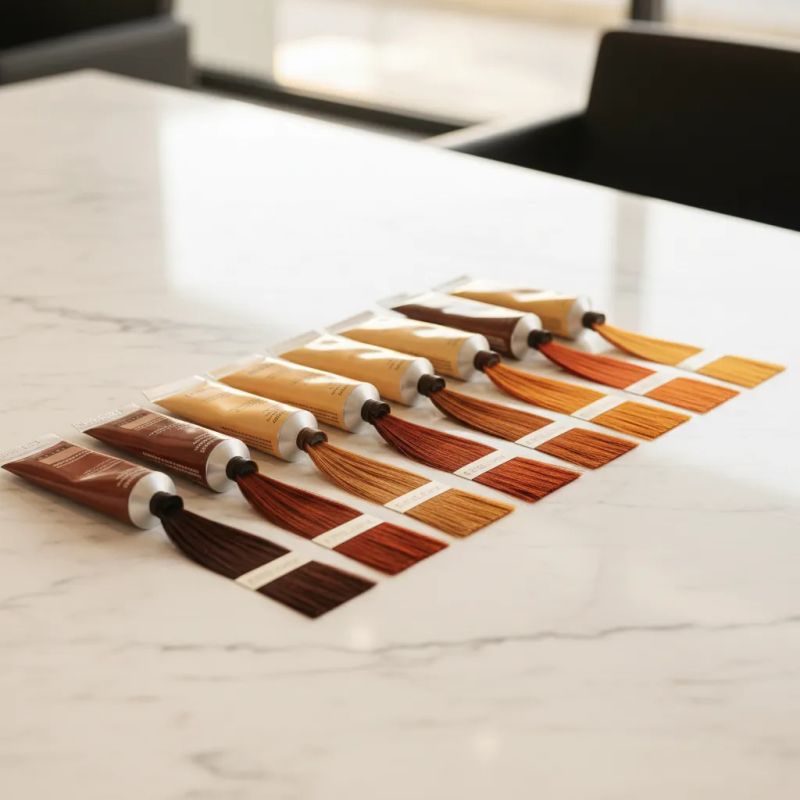
These formulas target level 7 (level 6 for dark copper) and use shades that exist on each brand’s chart. The split between shades isn’t printed on these charts: treat it as a salon starting point and fine-tune it on the strand test.
Wella (Koleston Perfect / Color Touch)
In Wella’s Koleston Perfect charts, the coppers sit in the Vibrant Reds family. They mix 1:1 with Welloxon Perfect and develop 30-40 minutes without heat.
| Goal | Koleston Perfect formula | Developer | Result |
|---|---|---|---|
| Spicy Ginger | 77/44 as the base, with 7/43 to add light | Welloxon Perfect 6% (20 vol) | Vibrant editorial copper |
| Subtle Ginger | 7/34 as the base; more gold with 7/3, more muted with a Pure Naturals shade at level 7 | Welloxon Perfect 6% (20 vol) | Natural golden copper |
| Dark Ginger | 6/43 as the base, with 6/4 if you want it more copper | Welloxon Perfect 6% (20 vol) | Deep sophisticated copper |
| Copper gloss | Color Touch 7/43 with a touch of 7/3 | Color Touch Emulsion 1.9% or 4%, 1:2 | Maintenance between visits |
6% is what Wella’s Koleston Perfect fact sheet assigns to 1 level of lift or to working at the same depth or darker. If the natural base has to come up further, the same sheet calls for 9% (30 vol) for 2 levels and 12% (40 vol) for 3.
Pro tip: Color Touch is a demi-permanent. Wella positions it for same-depth coloring, darkening or blending up to 50% gray, with 20 minutes’ development (15 with Climazon). That makes it the tool for refreshing copper between visits rather than for changing level.
Schwarzkopf (Igora Royal / Vibrance)
Schwarzkopf’s UK shop lists IGORA ROYAL coppers that include 9-7, 8-77, 7-77, 6-77 and 5-7, plus the 7-57 and 5-57 gold coppers. On the US IGORA chart, IGORA ROYAL mixes 1:1 with the IGORA ROYAL Oil Developer and develops 30-45 minutes. That chart’s developer guide gives 6% (20 vol) for tone-on-tone, coverage on white hair or 1-2 levels of lift, and 9% (30 vol) for 2-3 levels.
| Goal | IGORA ROYAL formula | Developer | Result |
|---|---|---|---|
| Spicy Ginger | 7-77 Medium Blonde Copper Extra, alone or with a touch of 7-57 to open it up | 6% (20 vol) | Intense copper with depth |
| Subtle Ginger | 7-57 Medium Blonde Gold Copper as the base; more muted with a little 7-0 | 6% (20 vol) | Natural golden copper |
| Dark Ginger | 6-77 Dark Blonde Copper Extra; deeper with some 5-7 Light Brown Copper | 6% (20 vol) | Dark dimensional copper |
| Copper + gray | Above 50% gray, 7-77 with 7-0 (or 7-4 Beige) in a 2:1 ratio; shade and natural in equal parts on thick, resistant hair | 6% (20 vol) | More muted copper, mixed for full coverage per the US chart |
The US chart doesn’t print a copper example: -77 isn’t among its 100% coverage series (-00, -0, -1, -4, -63), so the 2:1 rule it gives for the other shades applies, with a Natural (-0) or Beige (-4). To refresh mid-lengths and ends between visits, a demi-permanent such as IGORA VIBRANCE does the job; the US chart mixes it 1:1 (more in the maintenance section).
L’Oréal Professionnel (Majirel)
The codes in this table come from Majirel’s US color chart, which labels its coppers C (.4), CG (.43), CCC (.40) and CRv (.45). L’Oréal’s US usage table gives the ratio: 1:1.5, with 20- or 30-volume Majicrème developer.
| Goal | Majirel formula (US chart) | Developer | Result |
|---|---|---|---|
| Spicy Ginger | 7.40 (CCC) as the base, with 7.43 (CG) to add light | 20 vol (6%), 1:1.5 | Vibrant copper |
| Subtle Ginger | 7.3 (G) as the base, with 7.43 (CG) for the copper glint | 20 vol (6%), 1:1.5 | Soft luminous copper |
| Dark Ginger | 6.34 (GC) as the base; more copper and depth with some 5.4 (C). The chart has no 6.4 or 6.43, and 6.45 (CRv) already leans mahogany | 20 vol (6%), 1:1.5 | Deep golden copper |
How far each volume lifts is set on Majirel’s color chart for your market; the US usage table only lists 20- and 30-volume developer.
What Formulas Should You Use by Starting Level?
The starting level decides two things: how much lift you need and which underlying pigment will sit under the copper. On natural, uncolored hair, the color itself lifts. Wella’s Koleston Perfect fact sheet calls for 6% (20 vol) for 1 level of lift, 9% (30 vol) for 2 and 12% (40 vol) for 3. Schwarzkopf’s US IGORA chart gives 6% for 1-2 levels of lift and 9% for 2-3. For Majirel, the US usage table pairs it with 20- or 30-volume developer; how far each one lifts is on its color chart.
Those figures are written for natural hair, and Wella makes the point on its US professional blog: its bleach-free lifting techniques “are designed for lightening hair that has never been colored before”, and it warns that “Using a tint will not be sufficient if your client has previously colored hair”. The lightening curve in Wella’s Koleston usage booklet is also labeled “natural hair color level”. None of those figures account for lengths that already carry color, so the virgin root and the colored lengths get diagnosed separately. The full breakdown by volume is in our guide to developer volumes.
Before the table comes what doesn’t depend on the level. First, the allergy test: Wella’s Koleston Perfect leaflet puts it plainly (“Always perform an allergy test 48 hours before any color service”), and with any other line, follow the test its own instructions describe (how to schedule it without delaying the service). If the hair has a history (bleach, highlights, previous color or henna), test the copper on a hidden strand first (strand test). And if that strand has been lightened, run the elasticity test on it before adding more chemistry.
| Starting level (natural) | Underlying pigment exposed (Koleston curve) | What a level 7 copper needs | What to watch |
|---|---|---|---|
| 8-9 (light to very light blonde) | 8: yellow · 9: pale yellow | Deposit at the same level or darker, with the developer your data sheet assigns to darkening or tone-on-tone | If that 8-9 is natural, the color deposits over its own underlying pigment; if the lengths have been lightened (highlights or bleach), see the tip below the table |
| 7 (medium blonde) | Orange/yellow | Tone-on-tone: 6% in Koleston Perfect and IGORA ROYAL; for Majirel, the low end of the 20- or 30-volume range its US usage table lists | The underlying pigment already works for copper; it’s the easiest starting point |
| 5-6 (light brown to dark blonde) | 5: reddish/orange · 6: orange | Lift 1-2 levels with the color itself if the root is virgin: 6% for 1 and 9% for 2 in Koleston Perfect; 6% for 1-2 in IGORA ROYAL | That base adds red: lean on gold-copper before intense copper, or bring the target down to a level 6 copper |
| 3-4 (dark to medium brown) | 3: brown · 4: reddish/brown | From a virgin 4, reaching 7 takes the full 3 levels Koleston Perfect gives as its maximum with 12%: doable but tight, and the strand test confirms it; from a 3, getting to 7 takes lightener | A light copper that doesn’t find its base turns reddish. On the scalp, lightener goes with the developer on its own data sheet: Wella’s Blondor says not to exceed 6% (20 vol) |
| 1-2 (black) | 2: black | Color alone won’t get there: Koleston Perfect coppers lift 3 levels at most, with 12% | Lightener to open the base; how far and over how many sessions is decided by the strand test and the fiber’s condition |
If the lengths already carry color, the table applies to the root. On the lengths, the data sheet’s lift figures stop being a guide, and if the previous color sits darker than the target, the decision moves to color removal or lightening, always strand-tested first (our professional bleaching guide covers it). For a dark base, with formulas by level and pre-lightening, continue with copper on dark hair.
Pro tip: On heavily lightened hair (level 9-10 or highlights), copper has little warm underlying pigment to sit on, and the result can come out paler than planned. Wella sets when to put that pigment back first, in its guide to filling with Color Touch (US pro store): “When hair is ‘too light’ and the target level is more than two levels darker than the starting level, filling the hair is recommended.” Closer than that, the strand test tells you whether the copper holds.
What Application Techniques Work Best for Copper Results?
The application order depends on whether the hair is virgin or has regrowth. On a first color service on natural hair that has to lift, Wella starts on mid-lengths and ends and leaves the root for last; when the color only deposits at the same depth or darker, its usage booklet applies it from roots to ends in one go. On a retouch, the root goes first. Copper balayage adds dimension by keeping the root in Dark Ginger while lightening the face frame and ends, and the between-visit refresh is done with a demi-permanent when the reflect asks for it.
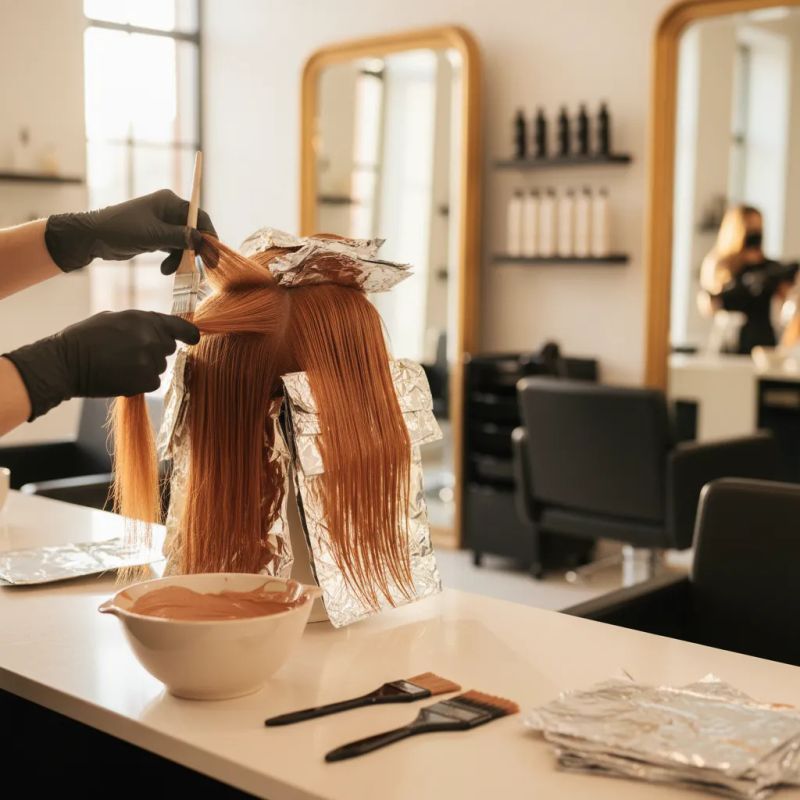
Not all coppers are applied the same way. The technique changes the final result as much as the formula.
Global (root to tip)
For a complete, uniform color change. On a first service on natural hair that also needs lift, Wella’s Koleston Perfect usage booklet applies the mix to lengths and ends only, leaving approximately 2 cm free from the scalp, and then to the roots, which for Vibrant Reds, the coppers’ family, develop 30-40 minutes without heat (15-25 with heat). How long the lengths sit before the roots go on comes from the Koleston Perfect instructions for your market. These steps and times are Koleston Perfect’s: on the US IGORA chart, IGORA ROYAL develops 30-45 minutes. Wella explains why the root goes last in its hot roots guide (US pro store): root hair is new, not yet fully keratinized, and processes faster, and scalp heat can add to it.
On a retouch the order flips: root first (30-40 minutes without heat in Koleston Perfect) and the lengths only to even things out. Koleston suggests dampening the hair at the end of the root time and emulsifying the color through the lengths for 5-10 minutes, or balancing with Color Touch. How much each section grabs depends on hair porosity, and the strand test shows it.
Copper balayage
Balayage adds natural dimension to copper. Apply the ginger formula with freehand sweeping on mid-lengths and ends, keeping the root natural or with Dark Ginger. The root-to-tip contrast creates a spectacular depth effect. Review the differences with traditional highlights in our guide on balayage vs highlights.
Maintenance gloss
Between visits, a demi-permanent brings copper’s vibrancy back when the reflect starts to fade. For Wella that’s Color Touch (the mix is in its table above); for Schwarzkopf, a demi-permanent like IGORA VIBRANCE. How to build that gloss and what to expect from it is in our hair gloss guide. For anyone wearing copper, it’s a natural recurring service.
For a softer take on the copper trend, the baby copper professional formula delivers a subtle warmth that works even for clients who have never worn copper before.
How to Correct a Copper That Went Wrong?
The three most common problems: carrot orange (straight copper went in on its own), too red or burgundy (the base was darker than the copper needed) and a copper that fades within a few washes, where porosity deserves a look before the developer does.
Here’s how to steer each one back.
Came out carrot orange instead of ginger: Usually straight copper was the only shade in the formula. To bring that orange down you need its complementary color (more gold on top won’t correct it): a touch of the blue family in a demi-permanent at the same level, which is ash (.1) at L’Oréal and, at Wella, the /8 its hot roots guide assigns to orange. The dose is whatever the strand asks for. In the next formula, let gold lead: at least as much gold-copper as copper.
Turned out too red / burgundy: The base was darker than the copper needed: on the Koleston curve, a 4 exposes reddish/brown and a 5 reddish/orange, and that red adds to the copper. Red is canceled with green, which the charts call matte: .7 at L’Oréal and /2 at Wella, the one its hot roots guide calls for on a red root. Watch L’Oréal’s .2: it’s iridescent (violet) and doesn’t correct red. Which complementary cancels which tone is in our guide to neutralizing unwanted tones. The other route is pushing the tone toward copper with more weight on gold in the next formula.
Faded within a week: Before blaming the developer, look at the hair. On pre-lightened or highlighted lengths that are porous toward the ends, copper tends to slip away sooner. If those lengths are also far lighter than the target (Wella’s filling guide draws the line at more than two levels darker), fill them first; if not, let the strand test show whether they hold the color. Developer and timing stay on the data sheet: if you only needed to deposit, the tone-on-tone or darkening volume, with the full development time, neither cut short nor stretched by eye. See our complete guide to professional color correction for more tangled cases.
Frequently asked questions
Can I mix coppers from different brands?
Not recommended. Each chart gives its mixes within its own line and with its own developer: Koleston Perfect with Welloxon Perfect, IGORA ROYAL with its Oil Developer, and Majirel, as its US chart puts it, “exclusively with Majicrème developers”. If your salon works with multiple brands, choose one for each complete service.
What dye-to-developer ratio should I use for coppers?
The one for its line’s standard shades: 1:1 for Koleston Perfect and IGORA ROYAL, 1:1.5 for Majirel and 1:2 for a demi-permanent like Color Touch. What changes is the developer volume, depending on how much lift you need (see the starting-level section). The line-by-line breakdown is in our guide to mixing ratios. Once the ratio is clear, the hair dye amount calculator gives you an estimate of color and developer grams based on length, density and service.
Does copper cover gray hair?
Yes, mixed with another shade according to the percentage, and each brand handles it its own way. Wella’s Koleston Perfect usage booklet places its coppers in the Vibrant Reds family, and that decides the math. For 30-50% white hair, its general rule applies: 1/3 of a Pure Naturals shade. Above 50%, the rule it gives for red shades does: 2 parts red shade to 1 part Pure Naturals (for other shades, the general rule adds 1/2). IGORA ROYAL’s rule is in its table above. And Majirel’s US chart, with more than 50% white and a warm target like copper, mixes half a tube of the shade with half a tube of the same level’s Gold (.3). The details by brand are in our gray coverage guide.
How often does copper need retouching?
It runs on two separate clocks: root growth, which gets retouched with permanent color, and how long the reflect takes to fade on the lengths, which gets refreshed with a demi-permanent. The second varies a lot from one head of hair to another, especially on lightened, porous hair (the why is in the corrections section). How to read both is in how often to retouch roots and tone.
Does copper work as balayage?
It is one of the best possible combinations. Copper balayage creates a “light trapped in the hair” effect that enhances the natural dimension of ginger. Plus, grow-out is less noticeable than with a global application.
In summary
- The formula defines the result: straight copper doesn’t go alone; pair it with a copper-gold or a gold at the same level, and use the natural as the brake
- Each brand writes copper its own way: /4 in Koleston Perfect, -7 in IGORA ROYAL, .4 in Majirel; the tables use shades that exist on those charts, each code with its own chart
- Starting level matters most: on natural hair, color lifts as far as its data sheet says (Koleston Perfect, 3 levels with 12%); beyond that you need lightener, and lengths with previous color get diagnosed separately
- The developer volume depends on how much lift you need, and each line sets it in its own developer guide
- The most common corrections start by reading the base and the porosity: blue for orange, matte for red, filling (when the gap in levels calls for it) for copper that slips away
Calculate copper formulas with AI
Want to generate the exact copper formula for the brand you use in your salon and each client’s starting level?
What's the difference between a copper and a professional ginger?
In the app, we ask you a question like this one, but about your own client.
Up for this week’s case? → More on brunettes and coppers →Related articles


The Blendsor newsletter
Color techniques and trends for professionals. No spam.
You know the theory. What about today's case?
Send a photo to the Blendsor advisor and get an answer grounded in colour theory: toner, developer and timing, with the brands on your shelf.
Ask about your caseWritten by the Blendsor team
Professional hair colorimetry experts with experience in AI-assisted formulation. We combine color science, salon practice and technology to help colorists formulate with precision.