How to Achieve Copper Hair on a Dark Base: Professional Guide
Achieve vibrant copper tones on dark hair. Formulas by starting level, application technique, and mistakes that ruin the result. For professional colorists.
Blendsor
Blendsor Team
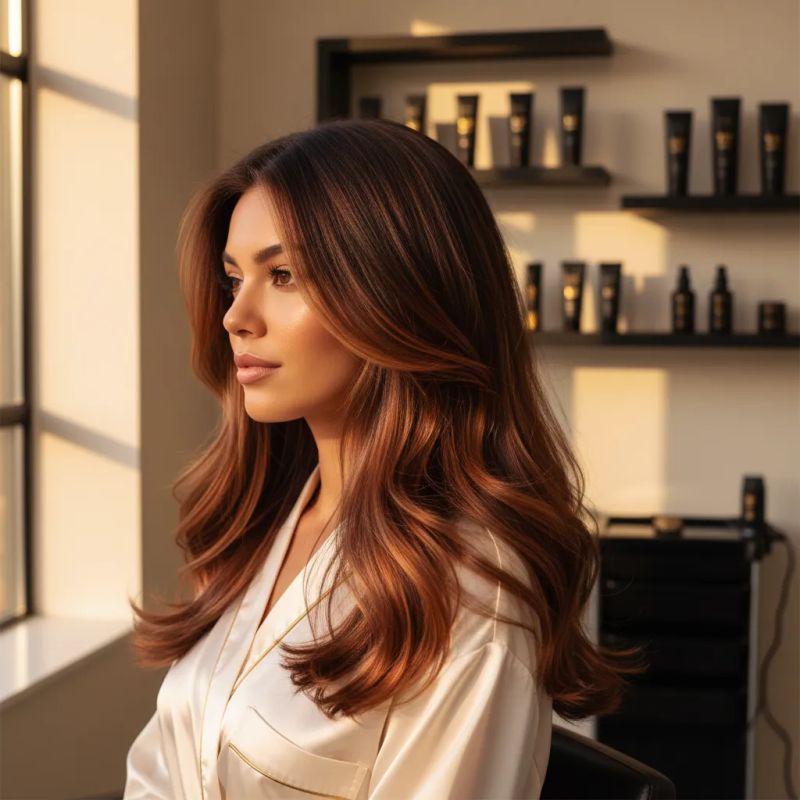
Your client shows you a copper photo from Instagram, points at the screen and says “I want this”… but they start at a level 4?
Achieving copper hair on a dark base is one of the most technically demanding services in the salon. The underlying pigment works against you, natural melanin competes with artificial pigment, and any formulation error turns a gorgeous editorial copper into a dull reddish-brown that looks nothing like the reference.
In this article you’ll see how to formulate vibrant coppers on dark bases (levels 4 through 6), when you need pre-lightening and how to avoid the mistakes that turn an editorial copper into a disaster. It’s part of the blog’s copper family, alongside Ginger Glow, copper formulas by brand, the subtle copper of baby copper and the difference between copper, peach and ginger, all within hair color trends.
Quick summary: on a dark base, start by separating virgin regrowth from lengths that already carry color. Permanent oxidative color lifts natural hair while it deposits the reflect (Koleston Perfect: up to 3 levels with 12%), but it won’t lift a previous tint. That’s why a deep copper often fits in a single application on virgin roots, and lightener comes in for two cases: lengths with previous color, or a copper lighter than the tint can reach. And in the bowl, straight copper always goes in with a copper-gold or a gold beside it.
Why Is Dark Hair a Challenge for Copper?
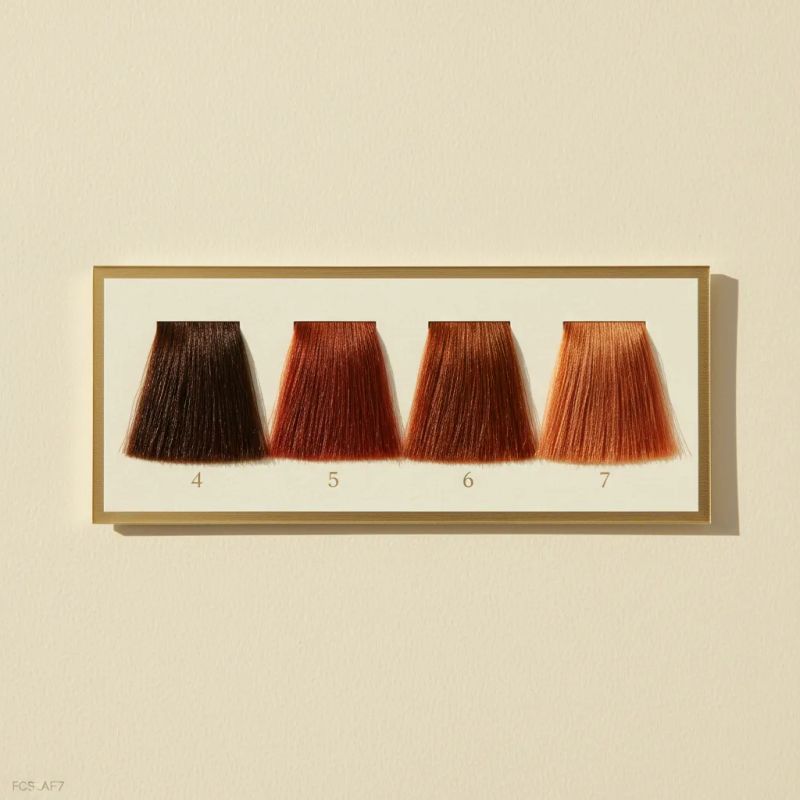
The main obstacle is the underlying pigment that surfaces as you lift. On the lightening curve Wella prints in its Koleston Perfect usage guidelines, a natural level 4 exposes reddish/brown and a level 5 reddish/orange; orange arrives at level 6 and orange/yellow at level 7. Copper landing on a reddish/brown base tends to read darker and redder than on the chart. On the orange of a 6 or the orange/yellow of a 7, the base works with it.
Copper on dark hair doesn’t come from putting a copper shade on and hoping for magic. That underlying pigment competes with the reflects you’re depositing, and the darker the starting point, the more weight it carries.
Schwarzkopf’s IGORA ROYAL technical manual (Spanish edition) explains it from the melanin side (p. 27): unwanted warm tones show up most when you lighten dark hair, because brown-black eumelanin dissolves more easily, while pheomelanin holds on and is revealed in the final stages of lightening, shifting from red to orange to yellow. That warmth coming up from a brunette is exactly what copper uses, as long as the base has reached the level where the reflect is going to live.
| Natural root level | Underlying pigment when lifted (Koleston curve) | What to check | What it usually calls for |
|---|---|---|---|
| 4 | Reddish/brown | How many levels you want to lift and whether the lengths carry color | Deep copper: a tint that lifts the virgin roots. Light copper or colored lengths: lightener first |
| 5 | Reddish/orange | Whether the red in the base suits the copper you’re after | A tint that lifts the virgin roots; lightener only where there’s previous color |
| 6 | Orange | Whether the copper is one or two levels away | A tint with the developer the lift calls for |
| 7+ | 7: orange/yellow · 8: yellow | Porosity of the lengths | Tone-on-tone permanent or a demi, depending on how long it should last |
The rule that holds up: the darker the starting level and the more levels you want to lift, the more prep the hair needs before copper can show. And that prep changes depending on whether the hair is virgin or already colored.
When Should You Pre-Lighten Before Applying Copper?
The decision depends on the natural level, the history of the lengths and how many levels you need to lift. On virgin roots, oxidative color lifts: Wella’s Koleston Perfect usage guidelines, with a 1:1 mix, give 6% (20 vol) for 1 level of lift or same-depth work, 9% (30 vol) for 2 levels and 12% (40 vol) for 3. On lengths with a previous tint, tint doesn’t lift: Wella says so on its US professional blog (“Using a tint will not be sufficient if your client has previously colored hair”) and points you to lightener. And if the copper you’re after sits above what the tint declares, you pre-lighten too.
This is the question that shapes the whole service. How far a tint lifts is declared line by line, and it isn’t the same across brands: Koleston gives 3 levels with 12%, while IGORA ROYAL’s Spanish manual (p. 10) reserves 9% (30 vol) for 2-3 levels of lift.
Three checks come before you decide. The allergy alert test comes before every color service, as the manufacturer’s instructions ask (Wella’s Koleston Perfect leaflet: “Always perform an allergy test 48 hours before any color service”); how to fit it into the book, in allergy patch test 48 hours. If the lengths have a history (bleach, highlights, previous color or henna), test the plan on a hidden strand first: that’s where you see whether the tint lifts, whether the copper grabs and what base is left (strand test). And if that strand has been bleached, check it wet before you think about more lightening: if it goes gummy, the hair elasticity test is telling you the lift can wait.
When to pre-lighten
You pre-lighten in two cases. First, when the lengths carry a previous tint: tint won’t lift it, whatever the developer. Second, when the light, luminous copper in the photo (Ginger Glow style) sits higher than the tint can lift from that natural level. Applying a light copper on a level 4 without lifting it is like trying to paint yellow over black: the result will be dark and flat.
The goal is not to reach blonde. It’s enough for the base to reach the level where the copper will live (the orange of a 6 or the orange/yellow of a 7 on the Koleston curve). How to control that lightening is covered in its own guide; the essentials come from Wella’s lightening guide for its Blondor powders (US edition): on the scalp, developer not exceeding 6% (20 vol), and a time limit that doesn’t stretch (“Do not exceed 50 mins. Check frequently”). Within that limit, you rinse when the base reaches where you want it.
Pro tip: a bond builder in the lightener bowl makes sense here, because you’re not chasing blonde, just opening the path, and the fiber needs to arrive intact for the second phase. The dose and when to add it come from its manufacturer, not from eyeballing: they’re in bond builder dosage for lightener.
When to apply directly
If the roots are virgin, the copper is only a few levels above natural and the client accepts a deeper, less gingery copper, the tint does both jobs at once: it lifts the natural and deposits the reflect. This is the route to a dark copper. With Koleston Perfect, on a virgin 5, a level-6 shade such as 6/43 lifts one level with 6%; on a 4, the same level-6 shade calls for 9%. For more intensity, the same family has 77/44 and mahogany coppers such as 6/45.
| Strategy | When | What you get | What sets the timing |
|---|---|---|---|
| Pre-lighten + copper | Lengths with previous color, or a copper lighter than the tint can reach | Light, luminous copper (Ginger Glow) | The lightener’s data sheet (Blondor: 50 min maximum), then the color’s |
| Tint that lifts and deposits | Virgin roots, copper a few levels away (Koleston: up to 3 with 12%) | Deep to medium copper | The tint’s data sheet (Koleston: 30-40 min without heat) |
| Tone-on-tone tint | A base already at the copper’s level | Copper reflect with no change in level | Koleston: 6% (20 vol), 30-40 min without heat |
| Copper gloss (demi) | Dark brown that isn’t going up | Shine and a copper glint in the light | Color Touch: 1:2 with its 1.9% or 4% emulsion, 20 min |
A copper gloss on dark brown hair is a common request, so it’s worth being clear about what it delivers. Wella positions its demi-permanent Color Touch for coloring on the same depth, darkening or blending up to 50% grey (usage guidelines): used that way on dark brown, it leaves shine and a copper glint that shows in the light, with no change in level. Wella’s same US professional blog also describes a soft lift with Color Touch, up to two levels with its 4% emulsion, for subtle highlights on clients who haven’t lightened their hair before; a light copper on a brunette is still a job for lifting tint or lightener. Technique and uses, in professional hair gloss.
What Are the Copper Formulas by Starting Level?
Formulas change with the level and with the history. On virgin roots, you pick the copper shade by the level you want to reach, and the developer by the levels you need to lift (with Koleston: 6% for one, 9% for two and 12% for three, mixed 1:1, 30-40 minutes without heat). On lengths that are already lightened, the copper goes on tone on tone. And the mix carries at least two reflects.
The examples use Koleston Perfect codes. On its US store blog, Wella says /4 is red (warm), the reflect for creating copper and strawberry blondes, and /3 is gold (yellow); these shades sit in the Vibrant Reds family. A reflect code only makes sense with its chart next to it: copper is -7 in Igora and .4 at L’Oréal (reading codes by brand is covered in copper, peach or ginger). For Igora, Majirel and other lines, see copper formulas by brand; for how each brand splits color and developer, hair dye mixing ratios.
Level 4: medium brown
Virgin roots, deep copper: a level-6 copper with 9% to lift two levels, such as 6/43. With 12% and a level-7 shade (7/43) you’re at the ceiling Koleston declares: the strand test tells you whether that hair gets there.
Light copper, or lengths with previous color:
- Step 1: lighten to the base of the target level. On natural hair, the Koleston curve gives orange at 6 and orange/yellow at 7; over a previous tint that curve stops being a guide and the base that shows may be a different one, so let the strand test decide where to stop.
- Step 2: copper tone on tone with 6% (20 vol), for example 7/43 with a touch of 7/34 if you want it softer, or a demi from the copper family with its own emulsion.
Level 5: light brown
Two paths depending on desired intensity:
Without pre-lightening (deep copper): 6/43 or 6/45 with 6% to lift one level, or 7/43 with 9% to lift two.
With pre-lightening (luminous copper, or colored lengths): lightener only on the zone that has to come up, to the base of a 6 or a 7; on virgin roots the tint may be enough. Then 7/43 with some 7/34, tone on tone with 6%.
Level 6: dark blonde
The most rewarding level for copper: the orange underlying pigment works for you rather than against you.
- Ginger Glow: 7/43 with the /4 in the lead, and some 7/34 when it needs softening (the same pair as the luminous copper for levels 4 and 5); 6% to lift one level.
- Intense copper: 77/44 as the base, with 7/43 to add light; 6%.
- Lighter golden copper: 8/43 with 9%, since that’s two levels.
Pro tip: if the copper comes out too loud on the strand, a Pure Naturals shade at the same level (Koleston 7/0 for a level 7) lowers the saturation without dulling it; how much is the strand’s call. And on gray, Koleston Perfect’s usage guide (2023) adds a Pure Naturals shade: 1/3 for 30-50% (its example: 15 g 7/0 + 45 g 7/75) and 1/2 for 50-100% (30 g + 30 g). It gives no separate ratio for Vibrant Reds, the family these coppers belong to.
What Is the Step-by-Step Application Technique for Copper on Dark Hair?
Application follows seven steps: diagnose the real level at roots and lengths; pre-lighten only where it’s needed (mid-lengths and ends first, roots last); mix enough fresh formula; on virgin hair that has to lift, color the lengths and ends first and the roots after; on a regrowth, start at the roots; respect the timing on the data sheet; and emulsify with a little water before rinsing.
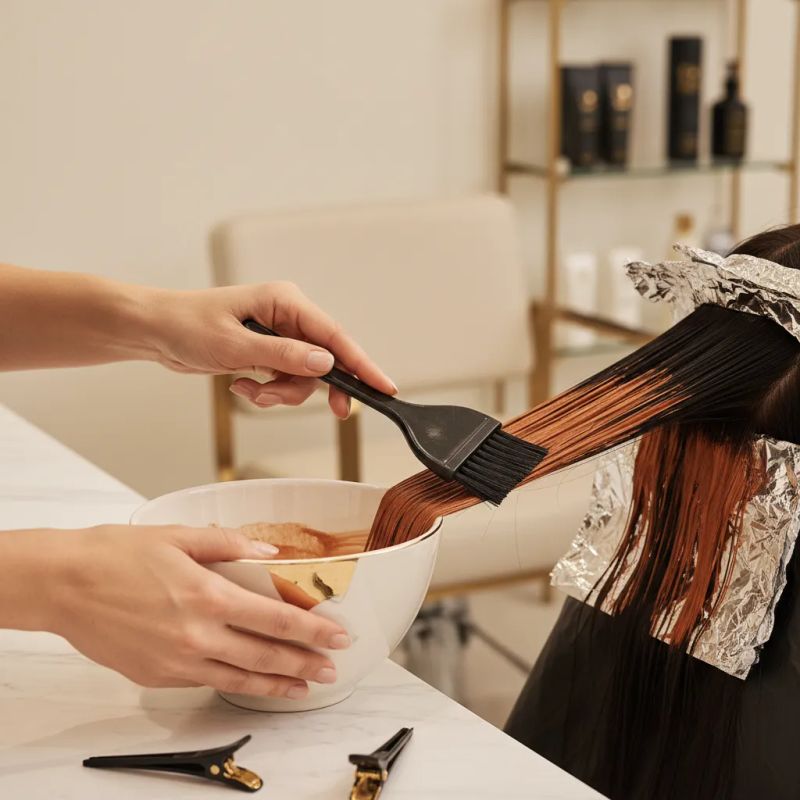
Technique matters as much as the formula. Poorly applied copper creates color bands and uneven saturation.
- Diagnosis: with the allergy test already done on the timing the color’s manufacturer gives (if it gives none, not on the same day as the color appointment), identify the actual natural level at the roots and the level of the lengths. Check front and back: Schwarzkopf’s IGORA ROYAL manual (Spanish edition) warns they can differ by up to two levels, and the client mostly sees the front (p. 26). If there’s previous color, the strand test decides whether it interferes
- Pre-lightening (if needed): lightener only where you need lift or where there’s previous color. On virgin hair, mid-lengths and ends first and roots last: Wella’s guide to hot roots explains that root hair is new, not yet fully keratinized, and processes faster, and that scalp heat can add to it. Don’t overlap lightener onto hair that’s already lightened (Blondor: “Do not overlap previously lightened hair with product”)
- Mix the formula: mix at the ratio on the data sheet (Koleston, 1:1) and apply it straight away. Make plenty, especially when lifting
- First-time application on virgin hair: when the tint has to lift, Wella’s Koleston leaflet starts on lengths and ends only, leaving about 2 cm untouched at the scalp (Vibrant Reds, 30 minutes without heat), then moves to the roots (30-40 minutes without heat)
- Regrowth: here you work the other way round, roots first, and if you’re lifting, you begin where the most lift is needed. Lengths are evened out at the end only if they need it: once the timing is up, the same leaflet suggests dampening them well and emulsifying the color through the lengths and ends for 5-10 minutes
- Time control: check lightener frequently, strand by strand; leave the tint on for the time on its data sheet, without cutting it short or stretching it. If the intensity falls short, that’s a fix for next time’s formula
- Emulsify and rinse: emulsify with a little warm water and rinse out well, as Koleston’s instructions say. Instead of a cold rinse to “seal”, which isn’t on the data sheet, Wella finishes with a post-color treatment that neutralizes oxidation residues and stabilizes the color
Copper hair with black tips (or black hair with copper tips)
Two colors on one head of hair, and each zone needs its own service. If the brief is copper on top and black on the tips, the tips only go darker, but if those tips have been lightened, that black needs a base under it. Schwarzkopf’s IGORA ROYAL manual (Spanish edition) uses a black result as its example (p. 28): on a pre-lightened base that’s too light, it comes out lighter and paler than intended, and if the hair is also porous, the red-orange pigments leave while the cool ones stay, for a matte, muddy or even green result; its fix is to pre-pigment. Wella draws the line at two levels in its guide to filling with Color Touch (US professional blog): “When hair is ‘too light’ and the target level is more than two levels darker than the starting level, filling the hair is recommended.” If those tips still carry a rich copper, that warm pigment is already doing part of the job, and the strand will show whether it’s enough.
If it’s the other way round, copper tips on dark hair, that zone has to come up: with tint only if the hair is virgin and the jump fits what the line declares; if those ends carry a dark tint, with lightener, because tint doesn’t lift tint.
Either way, isolate each zone as you apply (foil or film at the line) and, when rinsing, keep the water from the dark zone off the copper. Warn the client before you start: an oxidative black on the ends is one of the hardest colors to take out later. The design in the photo decides where the line falls, and the strand test shows whether each zone reaches its color.
What Are the Most Common Mistakes When Applying Copper on Dark Hair?
The five most common mistakes are: running straight copper alone on a level 4-5 (dull brownish copper), expecting from 40 vol what it can’t do (with Koleston it lifts natural hair up to 3 levels, but not a previous tint), ignoring the reddish base of a 4-5, using the same formula on roots and lengths, and leaving the color on longer to chase intensity.
These are the mistakes that keep coming back with copper on dark hair:
- Running straight copper alone on a level 4-5: without a copper-gold or a gold alongside it, you get a dull brownish copper with none of the luminosity the client expects. The fix is always combining at least two reflects (with Koleston, for example, 7/43 with 7/34)
- Expecting from 40 vol what it can’t do: “I’ll just use 40 volume.” With Koleston, 12% mixed 1:1 with the color is what the brand assigns to lifting natural hair up to 3 levels, and that’s as far as it goes. It won’t lift a previous tint, and it doesn’t replace lightening when you need to go higher. If unexpected reflects appear, check our guide on neutralizing unwanted tones
- Ignoring the underlying pigment: the reddish base of a level 4-5 adds to the copper. If you don’t account for it, the formula turns too red. If the strand reads more red than copper, give the gold more weight in the mix (a copper-gold instead of straight copper). And if what you want is to kill that red rather than turn it copper, that’s a different service: neutralizing a red undercoat without bleaching
- Using the same formula for roots and lengths: roots are at their natural level; lengths may be lighter, more porous or carry previous color. On top of that, porous hair absorbs more color and can end up darker than intended, as IGORA ROYAL’s Spanish manual warns (p. 26). The same formula on both zones gives an uneven result
- Leaving the color on longer to chase intensity: keeping the tint on past its data sheet doesn’t give more copper. If intensity isn’t there, the problem is in the formula or the base, not the clock
Frequently asked questions
Can you achieve copper without bleaching dark hair?
Yes, if the roots are virgin and the copper is only a few levels away: oxidative color lifts the natural while it deposits (with Koleston, up to 3 levels with 12%). If the lengths carry tint, or you want a light copper from a level 4, that zone needs lightening. Without lightening, the copper comes out deeper than it would with pre-lightening.
How long does copper last on dark hair?
There’s no number of weeks you can promise: it depends on the line, the porosity and how the hair is washed at home. The reflect is the first thing to go, even more so on lightened hair: IGORA ROYAL’s Spanish manual notes that red-orange pigments disappear quickly from porous ends (p. 28). A shampoo without sulfates and a copper-pigmented conditioner help between visits, and a demi brings the reflect back when it fades; when that’s due, in how often to retouch roots and tone.
Which developer should I use for copper on a dark base?
It depends on what the mix has to do. With tint on virgin roots, whatever the lift calls for: with Koleston, 6% (20 vol) for one level or same-depth work, 9% (30 vol) for two and 12% (40 vol) for three, mixed 1:1. On lengths that are already lightened you’re working tone on tone: 6% with Koleston, or a demi with its own emulsion (Color Touch goes 1:2 with 1.9% or 4%). What tint won’t do, not even at 12%, is lift a previous tint.
Does copper look the same on virgin hair vs previously colored hair?
No. Previously colored hair contains artificial pigments that change the result, and tint won’t lift it on top of that. A virgin level 5 and a level 5 with prior dark color react differently. On colored hair, always do a strand test before committing to the full formula.
Key takeaways
- Virgin roots and colored lengths aren’t treated the same: tint lifts the natural (with Koleston, up to 3 levels with 12%), but not a previous tint
- Level 4-5: a deep copper fits in one application on virgin roots; a light, luminous copper, or colored lengths, need lightening first
- Level 6: the sweet spot for copper, with shades like Koleston 7/43 or 77/44 and the developer the lift calls for
- Never run straight copper alone: combine at least two reflects (a copper-gold with a gold-copper, or a natural to lower saturation)
- The data sheet sets the time: minutes beyond what it asks for don’t add copper
Calculate personalized copper formulas with AI
Want to generate copper formulas adapted to each client’s starting level and exact brand?
Use the hair color mixing calculator to see which level and tone you get when you blend two copper shades, before you weigh them out.
Manufacturer sources
Manufacturer documents consulted for this article. A copy of each one is kept, and the passages noted from it are checked against that copy.
Note each one's country: the same line's instructions can differ from one market to another, so follow the directions for the product you use.
What happens if you apply copper over brunette without diagnosing the base?
In the app, we ask you a question like this one, but about your own client.
Up for this week’s case? → More on brunettes and coppers →Related articles



The Blendsor newsletter
Color techniques and trends for professionals. No spam.
You know the theory. What about today's case?
Send a photo to the Blendsor advisor and get an answer grounded in colour theory: toner, developer and timing, with the brands on your shelf.
Ask about your caseWritten by the Blendsor team
Professional hair colorimetry experts with experience in AI-assisted formulation. We combine color science, salon practice and technology to help colorists formulate with precision.